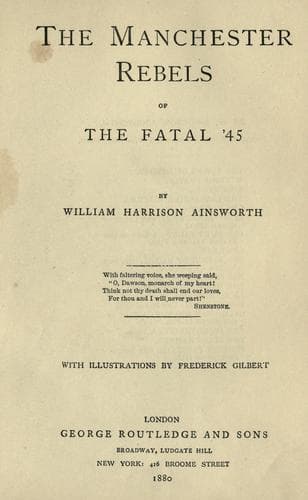
The Manchester Rebels of the Fatal '45Ainsworth, William Harrison
History
The Manchester Rebels of the Fatal '45
Ainsworth, William Harrison
Great Britain -- History -- George II, 1727-1760 -- Fiction; Jacobite Rebellion, 1745-1746 -- Fiction
Dismounting at the gate, he entered the mansion, and orders having
been given to that effect he was at once admitted to the prince, who
was alone in his private cabinet.
Charles instantly inquired if he had brought Sir Richard Rawcliffe
with him.
"He is unable to obey your royal highness's summons," replied the
other.
"How?" exclaimed the prince, frowning.
"He is lying dead at Rawcliffe, having perished by his own hand. But
he has left a written confession, wherein he acknowledges that he has
wrongfully deprived me of my inheritance."
"This is strange indeed!" exclaimed the prince. "His extraordinary
conduct to you is now explained, and the mystery that hung over your
birth is solved. You are the lost son of the former baronet. I
suspected as much, and meant to force the truth from Sir Richard.
However, he has spared me the trouble. Pray let me know all that has
occurred?"
Atherton then commenced his relation, to which the prince listened
with the greatest interest, and when the story was brought to a
conclusion he said:
"I will not affect to pity your unhappy uncle. He has escaped earthly
punishment, and perhaps the deep remorse he appears to have felt may
obtain him mercy on High. Let us hope so--since he has striven at the
last to make some amends for his heavy offences. But to turn to
yourself. Your position is now materially changed. You entered my
service as an unknown adventurer, and not as a wealthy baronet.
Considering this, and feeling, also, that I am under great personal
obligation to you, I will not wait for any solicitation on your part,
but at once release you from your engagement to me."
Atherton was much moved.
"Your royal highness overwhelms me by your kindness," he said. "But
though Rawcliffe Hall and its domains may be mine by right, I do not
intend to deprive Constance of the property. Furthermore, I shall not
assume my real name and title till the close of the campaign. For the
present I shall remain Atherton Legh. I trust your highness will
approve of the course I intend to pursue?"
"I do approve of it," replied Charles, earnestly. "The resolution you
have taken does you honour. Since you are determined to join me, it
shall not be as a mere officer in the Manchester Regiment, but as one
of my aides-de-camp. All needful explanation shall be given to Colonel
Townley. I shall march at an early hour in the morning. But no matter.
You can follow. You must see Constance before you leave, and if you
are detained by any unforeseen cause, I will excuse you. Nay, no
thanks. Good-night."
End of the Second Book.
BOOK III.
THE MARCH TO DERBY, AND THE RETREAT.
CHAPTER I.
AN OLD JACOBITE DAME.
Next morning the prince quitted Manchester, marching on foot at the
head of two regiments of infantry which formed the advanced guard. The
main body of the army, with the cavalry and artillery, was to follow
at a later hour.
Public-domain text, read in full here on John Shaqi.
Reviews
Reviews
No reviews yet
Be the first to share your thoughts on this work.
Elsewhere in the archive
Join the Discussion
Join the discussion
Sign in to leave a comment or review.
Sign InorCreate an account