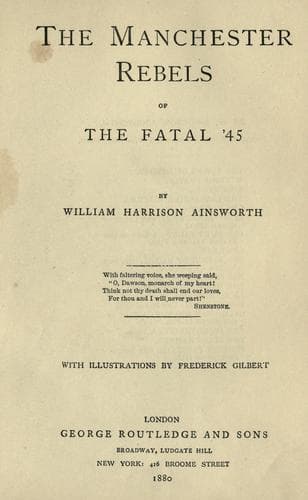
The Manchester Rebels of the Fatal '45Ainsworth, William Harrison
History
The Manchester Rebels of the Fatal '45
Ainsworth, William Harrison
Great Britain -- History -- George II, 1727-1760 -- Fiction; Jacobite Rebellion, 1745-1746 -- Fiction
"Pain me not by a refusal, I implore you, most gracious prince," she
said. "And think not you are depriving me of aught. I cannot live
long, and I have no children. 'Tis the last assistance I shall be able
to render your royal house--for which I have lived, and for which I
would die."
"I accept the gift, madam," replied Charles, with unaffected emotion,
"with as much gratitude as if you had placed a large sum at my
disposal. You are, indeed, a noble dame; and our family may well be
proud of a servant so loyal! If I succeed in my enterprise, I will
recompense you a hundred fold."
"I am fully recompensed by these gracious words, prince," she
rejoined.
"Nay, madam," he cried, pressing her hand to his lips; "mere thanks
are not enough. You have not confined yourself to words."
"My eyes are very dim, prince," said the old dame; "and what you say
to me will not make me see more clearly. Yet let me look upon your
face, and I will tell you what I think of you. I am too old to
flatter."
"You will not offend me by plain speaking," said Charles, smiling.
"You are a true Stuart," she continued, trying to peruse his features.
"But there are some lines in your comely countenance that bode----"
"Not misfortune, I trust?" said Charles, finding she hesitated.
She regarded him anxiously, and made an effort to reply, but could
not.
"What ails you, madam?" cried the prince, greatly alarmed by the
deathly hue that overspread her features.
Her strength was gone, and she would have fallen, if he had not caught
her in his arms.
Her friends, who were standing near, rushed forward to her assistance.
"Alas, all is over!" exclaimed Charles, mournfully, as he consigned
her inanimate frame to them.
"She is scarcely to be pitied, prince," said the Romish priest. "'Tis
thus she desired to die. May the angels receive her soul, and present
it before the Lord!"
"The sum she has bestowed upon me shall buy masses for the repose of
her soul," said Charles.
"Nay, prince," rejoined the priest. "Her soul is already at rest.
Employ the money, I beseech you, as she requested."
Much affected by this incident, Charles continued his march through a
fine champaign country, well-timbered and richly cultivated,
containing numerous homesteads, and here and there an old hall of the
true Cheshire type, and comprehending views of Bowden Downs and Dunham
Park on the left, with Norbury and Lyme Park on the right.
At Headforth Hall he halted with his body-guard, and claimed the
hospitality of its owner; while his troops marched on to Wilmslow, and
forced the inhabitants of that pretty little village to supply their
wants.
From Wilmslow the prince's march was continued to Macclesfield, where
he fixed his quarters at an old mansion near the Chester Gate.
CHAPTER II.
ATHERTON'S GIFT TO CONSTANCE.
Public-domain text, read in full here on John Shaqi.
Reviews
Reviews
No reviews yet
Be the first to share your thoughts on this work.
Elsewhere in the archive
Join the Discussion
Join the discussion
Sign in to leave a comment or review.
Sign InorCreate an account