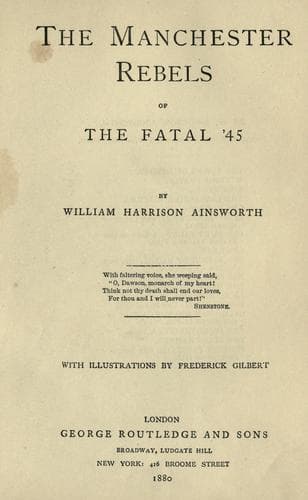
The Manchester Rebels of the Fatal '45Ainsworth, William Harrison
History
The Manchester Rebels of the Fatal '45
Ainsworth, William Harrison
Great Britain -- History -- George II, 1727-1760 -- Fiction; Jacobite Rebellion, 1745-1746 -- Fiction
The prince's departure from Manchester took place on Sunday, December
the 1st; but as the main body of the army did not leave till the
middle of the day, and great confusion prevailed in the town, no
service took place in the churches.
The cavalry was drawn up in St. Ann's Square; the different regiments
of infantry collected at various points in the town; and the
Manchester Regiment assembled in the collegiate churchyard.
While the troops were thus getting into order, preparatory to setting
out for Macclesfield, a great number of the inhabitants of the town
came forth to look at them--very much increasing the tumult and
confusion.
The Manchester Regiment got into marching order about noon, and was
one of the first to quit the town. Officers and men were in high
spirits, and looked very well.
As the regiment passed up Market Street Lane, with Colonel Townley
riding at its head, the colours borne by Ensign Syddall, and the band
playing, it was loudly cheered.
The regularity of the march was considerably interfered with by the
number of persons who accompanied their friends as far as Didsbury,
and supplied them rather too liberally with usquebaugh, ratifia, and
other spirituous drinks.
The courage of the men being raised to a high pitch by these
stimulants, they expressed a strong anxiety for an early engagement
with the Duke of Cumberland's forces, feeling sure they should beat
them.
After a short halt at Didsbury, their friends left them, and their
courage was somewhat cooled by fording the river below Stockport. They
were likewise obliged to wade through the little river Bollin, before
reaching Wilmslow, where they halted for the night.
Atherton had not yet left Manchester. He had some business to transact
which obliged him to employ a lawyer, and he was engaged with this
gentleman for two or three hours in the morning. He had previously
written to Constance to say that it was necessary he should see her
before his departure, and as soon as his affairs were arranged he rode
to Mrs. Butler's house in Salford.
Leaving his horse with Holden, by whom he was attended, he entered the
garden, and was crossing the lawn, when he encountered Jemmy Dawson,
who, having just parted with Monica, looked greatly depressed.
In reply to his anxious inquiries, Jemmy informed him that Constance
had borne the shock better than might have been expected, and had
passed the night in prayer. "I have not seen her," he said, "but
Monica tells me she is now perfectly composed, and however much she
may suffer, she represses all outward manifestation of grief. In this
respect she is very different from Monica herself, who, poor girl! has
not her emotions under control, and I left her in a state almost of
distraction."
Without a word more he hurried away, while Atherton entered the house,
and was shown into a parlour on the ground floor. No one was in the
room at the time, and his first step was to lay a packet on the table.
Public-domain text, read in full here on John Shaqi.
Reviews
Reviews
No reviews yet
Be the first to share your thoughts on this work.
Elsewhere in the archive
Join the Discussion
Join the discussion
Sign in to leave a comment or review.
Sign InorCreate an account