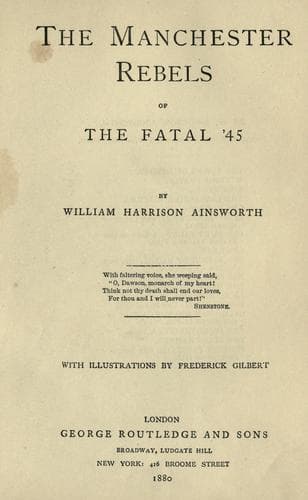
The Manchester Rebels of the Fatal '45Ainsworth, William Harrison
History
The Manchester Rebels of the Fatal '45
Ainsworth, William Harrison
Great Britain -- History -- George II, 1727-1760 -- Fiction; Jacobite Rebellion, 1745-1746 -- Fiction
Presently Constance made her appearance. Her features were excessively
pale, and bore evident traces of grief, but she was perfectly
composed, and Atherton thought he had never seen her look so
beautiful.
She saluted him gravely, but more distantly than before.
"I cannot condole with you on the terrible event that has occurred,"
he said; "but I can offer you my profound sympathy. And let me say at
once that I freely and fully forgive your unfortunate father for all
the wrong he has done me."
"I thank you for the assurance," she rejoined. "'Tis an infinite
relief to me, and proves the goodness of your heart."
"Do not dwell upon this, Constance," he said. "Hereafter we will talk
over the matter--not now. Should you feel equal to the journey, I hope
you will immediately return to Rawcliffe."
"I will return thither, with your kind permission, to see my poor
father laid in the family vault. That sad duty performed, I shall quit
the house for ever."
"No, Constance--that must not be," he rejoined. "My object in coming
hither this morning is to tell you that I do not design to dispossess
you of the house and property. On the contrary, you will be as much
the mistress of Rawcliffe Hall as ever--more so, perhaps. Nay, do not
interrupt me--I have not finished. Many things may happen. I may meet
a soldier's fate. The hazardous enterprise I am bent upon may fail--I
may be captured--may die as a rebel on the scaffold. If I should not
return, the house and all within it--all the domains attached to
it--are yours. By that deed I have made them over to you."
And he pointed to the packet which he had laid upon the table.
Constance was greatly moved. Tears rushed to her eyes, and for a few
minutes she was so overpowered that she could not speak.
Atherton took her hand, which she did not attempt to withdraw.
"I am profoundly touched by your generosity," she said. "But I cannot
accept your gift."
"Nay you must accept it, dearest Constance," he said. "You well know
you have my heart's love, and I think you will not refuse to be mine."
"'Twould be too great happiness to be yours," she rejoined. "But
no--no--I ought not to consent."
By way of reply, he pressed her to his heart, and kissed her
passionately.
"Now will you refuse?" he cried.
"How can I, since you have wrested my consent from me?" she rejoined.
"But how am I to address you?"
"You must still call me Atherton Legh," he replied.
"Well, then, dearest Atherton, my heart misgives me. In urging you to
join this expedition I fear I have done wrong. Should any misfortune
happen to you I shall deem myself the cause of it. I tremble to think
of the consequences of my folly. Must you go?" she added, looking
imploringly at him.
"Yes," he replied. "Not even you, dearest Constance, can turn me from
my purpose. The prince has relieved me from my engagement, but I
cannot honourably retire. Come what may, I shall go on."
Public-domain text, read in full here on John Shaqi.
Reviews
Reviews
No reviews yet
Be the first to share your thoughts on this work.
Elsewhere in the archive
Join the Discussion
Join the discussion
Sign in to leave a comment or review.
Sign InorCreate an account