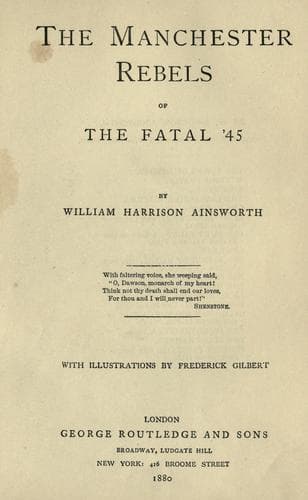
The Manchester Rebels of the Fatal '45Ainsworth, William Harrison
History
The Manchester Rebels of the Fatal '45
Ainsworth, William Harrison
Great Britain -- History -- George II, 1727-1760 -- Fiction; Jacobite Rebellion, 1745-1746 -- Fiction
Surrounded by walls built in the time of Henry the Eighth, Carlisle,
at the period of our history, boasted a fortress that had successfully
resisted many an attack made upon it by the Scots.
Situated on an eminence, and partly surrounded by a broad, deep moat,
fed by the river Eden, the citadel, strongly garrisoned and well
provided with guns and ammunition, would seem to be almost impregnable.
At the foot of the western walls flowed the river Caldew, while the
castle overlooked the beautiful river Eden.
On the summit of the keep floated the prince's standard, and from this
lofty station remarkably fine views could be obtained. On one side
could be noted the junction of the Caldew and the Eden that takes
place below the castle, and adds to the strength of its position. The
course of the Eden could likewise be traced as it flowed through
fertile meadows, to pour its waters, augmented by those of the Caldew,
into the Solway Firth.
From the same point of observation could likewise be descried the
borders of Dumfries, with the Cheviot Hills on the right, while on the
other side the view extended to the stern grey hills of
Northumberland. Looking south, the eye ranged over a sweeping tract in
the direction of Penrith. Of course the keep looked down upon the
ancient cathedral which closely adjoined the castle, and upon the town
with its old gates and bulwarks.
Though the walls had become dilapidated, and were of no great
strength, yet, from its position and from its castle, it would seem
that Carlisle was able to stand a lengthened siege; and such was the
opinion of Colonel Townley, who considered it tenable against any
force that could be brought against it by the Duke of Cumberland.
One important matter, however, could not be overlooked. The
inhabitants were hostile, and were only controlled by the garrison. In
Carlisle, as in all Border towns, there was an hereditary dislike of
the Scots, and this feeling had been heightened by the recent events.
Immediately after the prince's departure, Colonel Townley examined the
walls, and caused certain repairs to be made. Guns were mounted by his
direction, and chevaux de frise fixed at all the gates and entrances.
A house from which the prince's army had been fired upon was likewise
burnt, to intimidate the inhabitants; and notice was given that any
violation of the commandant's orders would be severely punished. A
sallying party was sent out under the command of Captain Legh to
procure forage and provisions, and returned well supplied.
Amongst the most active and efficient of the officers was Tom Syddall,
who had now been raised to the post of adjutant, and rendered the
colonel great service. As the number of men ran short, Parson Coppock,
whose military ardour equalled his religious zeal, abandoned his gown
and cassock, and putting on military accoutrements, acted as
quarter-master to the regiment.
Public-domain text, read in full here on John Shaqi.
Reviews
Reviews
No reviews yet
Be the first to share your thoughts on this work.
Elsewhere in the archive
Join the Discussion
Join the discussion
Sign in to leave a comment or review.
Sign InorCreate an account