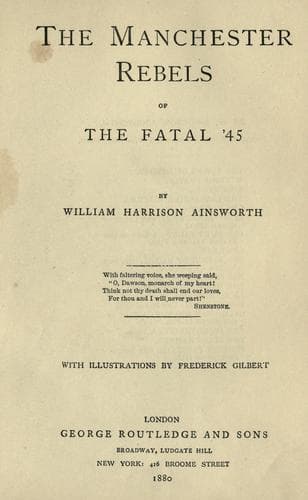
The Manchester Rebels of the Fatal '45Ainsworth, William Harrison
History
The Manchester Rebels of the Fatal '45
Ainsworth, William Harrison
Great Britain -- History -- George II, 1727-1760 -- Fiction; Jacobite Rebellion, 1745-1746 -- Fiction
The greatest zeal and activity were displayed both by the officers and
men of the corps, and Colonel Townley seemed almost ubiquitous.
Colonel Hamilton lacked the spirit and energy displayed by the
commandant of the town, and was content to remain quietly shut up
within the walls of the castle, leaving the more arduous duties to
Colonel Townley, who discharged them, as we have shown, most
efficiently. Moreover, though he kept the opinion to himself, Colonel
Hamilton felt that the garrison would be compelled to capitulate,
unless it should be reinforced.
By the end of the third day all possible preparations for the siege
had been made by Colonel Townley, and he now deemed himself secure.
On the following day Captain Legh was sent with a message to the
governor, and found the castle in a good state of defence. The
court-yard was full of Highland soldiers; a few cannon were planted on
the battlements, and sentinels were pacing to and fro on the walls.
Colonel Hamilton was on the esplanade at the time, conversing with
Captain Abernethy and some other Scottish officers, and Atherton
waited till he was disengaged to deliver his message to him; but
before the governor could send a reply, a small party of horse, with
an officer at their head, could be seen approaching the city from the
Penrith Road.
Evidently they were English dragoons. After reconnoitring for a few
moments, Colonel Hamilton gave his glass to Atherton, who thought they
must be coming to summon the city to surrender.
"No doubt of it," replied the governor. "I wonder what Colonel
Townley's answer will be?"
"A scornful refusal," rejoined Captain Legh, surprised.
"That is all very well now," remarked the governor, shrugging his
shoulders; "but we shall have to capitulate in the end."
"Does your excellency really think so?"
"I do," replied Hamilton.
The answer returned by Colonel Townley was such as Atherton had
anticipated. He positively refused to surrender the city, and declared
he would hold it to the last extremity.
On the following day the Duke of Cumberland appeared before the town
with his whole army, and immediately began to invest it on all sides.
He continued his siege operations for nearly a week, during which a
constant fire was kept up from the walls and from the larger guns of
the castle, and frequent sallies were made by the garrison. One of
these, headed by Captain Legh, was attended with some little success.
He drove the enemy from their trenches, and nearly captured the Duke
of Richmond.
Hitherto, the besieged party had sustained very little damage, and had
only lost a few men. The duke had not indeed opened fire upon them,
because he had not received some artillery which he expected from
Whitehaven.
Public-domain text, read in full here on John Shaqi.
Reviews
Reviews
No reviews yet
Be the first to share your thoughts on this work.
Elsewhere in the archive
Join the Discussion
Join the discussion
Sign in to leave a comment or review.
Sign InorCreate an account