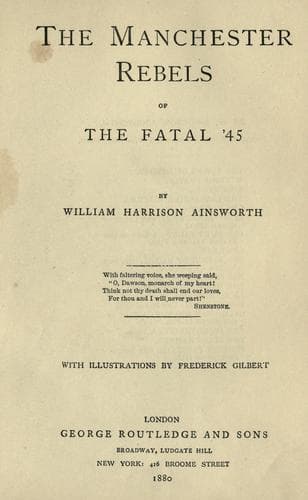
The Manchester Rebels of the Fatal '45Ainsworth, William Harrison
History
The Manchester Rebels of the Fatal '45
Ainsworth, William Harrison
Great Britain -- History -- George II, 1727-1760 -- Fiction; Jacobite Rebellion, 1745-1746 -- Fiction
Colonel Townley, therefore, continued in high spirits, and even
Colonel Hamilton acquired greater confidence. One morning, however,
they were startled by perceiving a six-gun battery, which had been
erected during the night. Colonel Townley did not lose courage even at
this sight; but the governor was seriously alarmed.
"We shall be compelled to submit," he said; "and must make the best
terms we can."
"Submit! never!" cried Colonel Townley. "We had better die by the
sword than fall into the hands of those cursed Hanoverians. The duke
will show us no mercy. Oh that we could but get possession of those
guns!"
"Give me twenty well-mounted men and a dozen led horses, and I will
bring off a couple of the guns," cried Atherton.
"The attempt were madness," cried Colonel Townley.
"Madness or not, I am ready to make it," rejoined Captain Legh.
Half-an-hour afterwards the north gate, which was nearest the battery,
was suddenly thrown open, and Captain Legh, mounted on a strong horse,
and followed by twenty well-mounted men, half of whom had spare horses
furnished with stout pieces of rope, dashed at a headlong pace towards
the battery. The attack was so sudden and unexpected that the enemy
was quite taken by surprise. Only an officer of artillery and
half-a-dozen artillerymen were near the battery at the time, and
before they could fly to their guns, Captain Legh and his party were
upon them, and drove them off. A desperate effort was made to carry
off two of the guns, but it was found impossible to move the heavy
carriages.
The Duke of Cumberland, who was at a short distance with his
aide-de-camp, Colonel Conway, planning and directing the operations,
witnessed the attack, and instantly ordered Conway with a troop of
horse to seize the daring assailants.
But the latter dashed off as hard as they could to the gate, and
gained it just in time. All got in safely with the exception of their
leader, who was captured by Colonel Conway and led back to the duke.
CHAPTER III.
THE DUKE OF CUMBERLAND.
William, Duke of Cumberland, second surviving son of the reigning
sovereign, was at this time a handsome young man of twenty-four.
Strongly built, but well proportioned, he had bluff and rather coarse
but striking features. Young as he was, the duke had gained
considerable military experience. He had fought with his father,
George the Second, at the battle of Dettingen, in 1743, and in May,
1745, he engaged Marshal Saxe at Fontenoy, and sustained a most
crushing defeat--highly prejudicial to English renown.
Public-domain text, read in full here on John Shaqi.
Reviews
Reviews
No reviews yet
Be the first to share your thoughts on this work.
Elsewhere in the archive
Join the Discussion
Join the discussion
Sign in to leave a comment or review.
Sign InorCreate an account