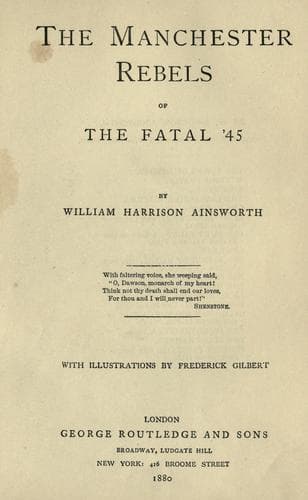
The Manchester Rebels of the Fatal '45Ainsworth, William Harrison
History
The Manchester Rebels of the Fatal '45
Ainsworth, William Harrison
Great Britain -- History -- George II, 1727-1760 -- Fiction; Jacobite Rebellion, 1745-1746 -- Fiction
On the following morning the besieged town of Carlisle presented a
singular spectacle. The inhabitants, who had hitherto been kept in awe
by the garrison, assembled in the streets, and did not attempt to hide
their exultation; while the Highlanders in the castle, and the
officers and men of the Manchester Regiment, looked deeply dejected,
and stood listlessly at their posts. The cause of all these mingled
feelings of ill-concealed satisfaction on one side, and deep dejection
on the other, was, that the garrison had declared its intention to
surrender by hanging out the white flag. The men still stood to their
arms--the engineers and artillerymen remained upon the walls--the
gates of the city were still guarded--but not a gun had been fired.
All was terrible expectation.
Colonel Hamilton, Captain Abernethy, Colonel Townley, and some of the
officers of the Manchester Regiment, were assembled on the esplanade
of the castle, when Captain Vere, an officer of the English army,
attended by an orderly, rode towards them. As the bearer of a despatch
for the governor, he had been allowed to enter the city.
Dismounting, Captain Vere marched up to the governor, and, with a
formal salute, delivered a missive to him, saying, "This from his
royal highness."
The governor took the letter, and, walking aside with Colonel Townley,
read as follows:
"'All the terms his royal highness will or can grant to the rebel
garrison of Carlisle are, that they shall not be put to the sword, but
be reserved for the king's pleasure.'"
"The king's pleasure!" exclaimed Colonel Townley. "We have nothing but
death to expect from the usurper. But go on."
"'If they consent to these conditions, the governor and the principal
officers are to deliver themselves up immediately; and the castle,
citadel, and all the gates of the town are to be taken possession of
forthwith by the king's troops."
"I cannot make up my mind to this," cried Colonel Townley.
"Unfortunately there is no help for it," observed Colonel Hamilton.
"But hear what follows: 'All the small arms are to be lodged in the
town guard-room, and the rest of the garrison are to retire to the
cathedral, where a guard is to be placed over them. No damage is to be
done to the artillery, arms, or ammunition.' That is all."
"And enough too," rejoined Colonel Townley. "The conditions are
sufficiently hard and humiliating."
"Gentlemen," said the governor, addressing the officers, "'tis proper
you should hear the terms offered by the duke."
And he proceeded to read the letter to them.
Murmurs arose when he had done, and a voice--it was that of Adjutant
Syddall--called out:
"Reject them!"
"Impossible," exclaimed Hamilton.
Thinking he had been kept waiting long enough, Captain Vere then
stepped forward and enquired, "What answer shall I take to his royal
highness?"
Colonel Townley and his officers were all eagerness to send a refusal;
but the governor cried out, "Tell the duke that his terms are
accepted."
Public-domain text, read in full here on John Shaqi.
Reviews
Reviews
No reviews yet
Be the first to share your thoughts on this work.
Elsewhere in the archive
Join the Discussion
Join the discussion
Sign in to leave a comment or review.
Sign InorCreate an account