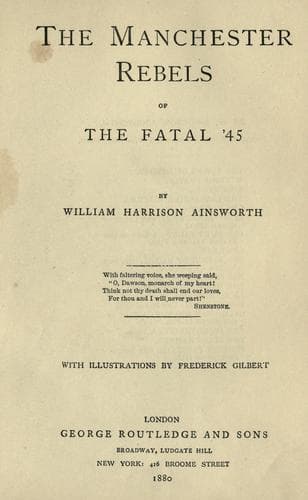
The Manchester Rebels of the Fatal '45Ainsworth, William Harrison
History
The Manchester Rebels of the Fatal '45
Ainsworth, William Harrison
Great Britain -- History -- George II, 1727-1760 -- Fiction; Jacobite Rebellion, 1745-1746 -- Fiction
"In that case, gentlemen," said Captain Vere, "you will all prepare to
deliver yourselves up. His royal highness will at once take possession
of the town."
With this, he mounted his horse, and rode off, attended by his
orderly.
About an hour afterwards, the gates being thrown open, Brigadier Bligh
entered the town with a troop of horse, and rode to the market-place,
where, in front of the guard-room, he found Colonel Hamilton, Captain
Abernethy, Colonel Townley, and the officers of the Manchester
Regiment, a French officer, and half a dozen Irish officers.
They all yielded themselves up as prisoners, and the brigadier desired
them to enter the guard-room, and when they had complied with the
order, placed a guard at the door.
The Highlanders, the non-commissioned officers and privates of the
Manchester Regiment, with a few French and Irish soldiers, who were
drawn up in the market-place, then piled their arms, and retired to
the cathedral, where a strong guard was set over them.
Crowded with these prisoners, the interior of the sacred building
presented a very singular picture. Most of the men looked sullen and
angry, and their rage was increased when the sound of martial music
proclaimed the entrance of the Duke of Cumberland with his whole army
into the town.
Attended by General Hawley, Colonel Conway, Colonel York, and a large
staff of officers, the duke was received with acclamations by the
townspeople who had come forth to meet him. Riding on to the citadel,
he dismounted with his staff, and, entering a large room recently
occupied by the governor, ordered the prisoners to be brought before
him. After charging them with rebellion and treason, he told them they
would be sent under a strong guard to London, there to take their
trial.
When he had finished, Colonel Townley stepped forward, and said:
"I claim to be treated as a prisoner of war. For sixteen years I have
been in the service of the King of France, and I now hold a commission
from his majesty, which I can lay before your royal highness if you
will deign to look at it."
"But you have received another commission from the son of the
Pretender, and have acted as colonel of the rebel regiment raised by
yourself in Manchester," interposed General Hawley. "Your plea is
therefore inadmissible."
"I have as much right to the cartel as any French officer taken by his
royal highness at the battle of Fontenoy," rejoined Townley.
"As a liege subject of his majesty, you are not justified in serving a
prince at war with him," said the Duke of Cumberland, sternly. "I
cannot entertain your plea. You will be tried for rebellion and
treason with the rest of the prisoners."
Seeing it would be useless to urge anything further, Colonel Townley
stepped back.
The only person allowed the cartel was the French officer.
The prisoners were then removed, and ordered to be kept in strict
confinement in the castle until they could be conveyed to London.
Public-domain text, read in full here on John Shaqi.
Reviews
Reviews
No reviews yet
Be the first to share your thoughts on this work.
Elsewhere in the archive
Join the Discussion
Join the discussion
Sign in to leave a comment or review.
Sign InorCreate an account