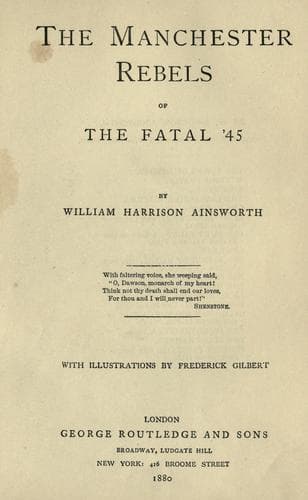
The Manchester Rebels of the Fatal '45Ainsworth, William Harrison
History
The Manchester Rebels of the Fatal '45
Ainsworth, William Harrison
Great Britain -- History -- George II, 1727-1760 -- Fiction; Jacobite Rebellion, 1745-1746 -- Fiction
Some deserters from the king's army were then brought before the duke,
who ordered them to be hanged, and the sentence was forthwith carried
out on a piece of ground at the back of the castle.
The prisoners passed the night in strict confinement in the castle,
their gloom being heightened by the sound of the rejoicings that took
place in the town at the Duke of Cumberland's success.
On the following morning, at an early hour, three large waggons, each
having a team of strong horses, were drawn up near the gates of the
castle. These were destined to convey the prisoners to London. The
foremost waggon was assigned to Colonel Townley, Captain Dawson,
Captain Deacon, and Captain Legh. The rest of the officers of the
Manchester Regiment were similarly bestowed. A strong mounted guard
accompanied the conveyances, having orders to shoot any prisoner who
might attempt to escape.
As the waggons moved slowly through the streets towards the south
gate, groans and execrations arose from the spectators, and missiles
were hurled at the prisoners, who no doubt would have fared ill if
they had not been protected.
The Duke of Cumberland remained for two days longer at Carlisle, when
having received a despatch from the king enjoining his immediate
return, as an invasion from France was apprehended, he posted back to
London, taking Colonel Conway with him, and leaving the command of the
army to General Hawley, who started in pursuit of Prince Charles.
End of the Fourth Book.
BOOK V.
JEMMY DAWSON.
CHAPTER I.
THE ESCAPE AT WIGAN.
The prisoners were treated very considerately on their journey to
London. Whenever the waggons stopped at an inn, their occupants were
allowed to alight and order what they pleased, and as they had plenty
of money, they were served with the best the house could afford. At
night they sometimes slept in the waggons, sometimes at an inn, if
sufficient accommodation could be found. In the latter case, of
course, a guard was placed at the doors.
Passed in this way, the journey might not have been disagreeable, if
it had not been for the indignities to which they were occasionally
exposed. None of the officers felt any great uneasiness as to their
fate. Despite what the Duke of Cumberland had said to Colonel Townley,
they were led to expect that they would be treated as prisoners of
war, and regularly exchanged.
Entertaining this conviction, they managed to keep up their spirits,
and some of them led a very jovial life.
A great change, however, had taken place in Colonel Townley's
deportment. He had become extremely reserved, and associated only with
Captain Deacon, Captain Dawson, and Atherton. The two latter would
have been far more cheerful if they had obtained any tidings of those
to whom they were tenderly attached.
Public-domain text, read in full here on John Shaqi.
Reviews
Reviews
No reviews yet
Be the first to share your thoughts on this work.
Elsewhere in the archive
Join the Discussion
Join the discussion
Sign in to leave a comment or review.
Sign InorCreate an account