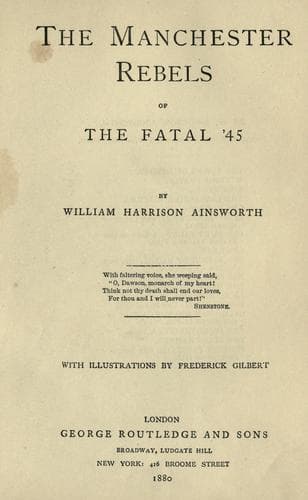
The Manchester Rebels of the Fatal '45Ainsworth, William Harrison
History
The Manchester Rebels of the Fatal '45
Ainsworth, William Harrison
Great Britain -- History -- George II, 1727-1760 -- Fiction; Jacobite Rebellion, 1745-1746 -- Fiction
Enraged at my attempt at flight, the officer in command of the
guard threatened to fetter me, like a common felon, but as yet I
have been spared that indignity.
You will easily imagine the state of grief and despair into which
I was plunged by my ill success. I had buoyed myself up with false
hopes. I felt quite sure that in a few days I should again clasp
you to my heart. Deprived by a cruel fate of such unspeakable
happiness, can you wonder at my distraction? While thus frenzied,
had I possessed a weapon, I should certainly have put an end to my
wretched existence. But I am somewhat calmer now, though still
deeply depressed.
Oh! dearest Monica--the one being whom I love best!--I cannot
longer endure this enforced separation from you. Never till now
did I know how necessary you are to my existence. Pity me! pity
me! I am sore afflicted.
Your presence would restore the serenity of mind I once enjoyed,
and which I have now utterly lost. Come to me, and shed a gleam of
happiness over the residue of my life. In a few days I shall be
lodged in a prison, but I shall not heed my confinement if you
will visit me daily.
Should the worst fate befall me--as I have sad presentiments that
it will--I shall be prepared to meet it, if you are with me at the
last. Without you to strengthen me, my courage may fail. I need
you, dearest Monica--need you more than ever. Come to me, I
implore you!
I am ashamed of what I have written, but you will not despise me
for my weakness. 'Tis not imprisonment I dread, but the torture of
prolonged separation from you. Did I not love you so passionately
I should be as careless as my companions in misfortune. They have
little sympathy for me, for they cannot understand my grief. They
would laugh at me if I told them I was ever thinking of you. Most
of them live jovially enough, and appear entirely unconcerned as
to the future. Whether they are really as indifferent as they
seem, I much doubt. But they drink hard to drown care. The two
Deacons, however, keep aloof from the rest. Colonel Townley, also,
is greatly changed. He does not look downcast, but he has become
exceedingly serious, and passes his time in long discourses with
Father Saunderson, his priest and confessor, who is allowed to
attend him. He often talks to me of you and Constance, and hopes
that Atherton has been able to embark for France. We have heard
nothing of the latter, of course; and in his case no news is good
news.
Public-domain text, read in full here on John Shaqi.
Reviews
Reviews
No reviews yet
Be the first to share your thoughts on this work.
Elsewhere in the archive
Join the Discussion
Join the discussion
Sign in to leave a comment or review.
Sign InorCreate an account