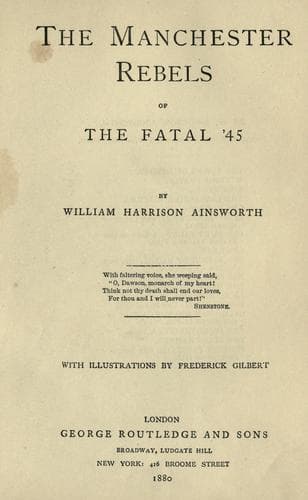
The Manchester Rebels of the Fatal '45Ainsworth, William Harrison
History
The Manchester Rebels of the Fatal '45
Ainsworth, William Harrison
Great Britain -- History -- George II, 1727-1760 -- Fiction; Jacobite Rebellion, 1745-1746 -- Fiction
Colonel Townley was first arraigned, and maintained an undaunted
demeanour. When he appeared in the dock a murmur ran through the
crowded court, which was immediately checked. The counsel for the king
were the Attorney-General, Sir John Strange, the Solicitor-General,
Sir Richard Lloyd, and the Honourable Mr. York--those for the prisoner
were Mr. Serjeant Wynne and Mr. Clayton. The prisoner was charged with
procuring arms, ammunition, and other instruments, and composing a
regiment for the service of the Pretender to wage war against his most
sacred majesty; with marching through and invading several parts of
the kingdom, and unlawfully seizing his majesty's treasure in many
places for the service of his villainous cause, and taking away the
horses and other goods of his majesty's peaceful subjects. The
prisoner was furthermore charged, in open defiance of his majesty's
undoubted right and title to the crown of these realms, with
frequently causing the Pretender's son to be proclaimed in a public
and solemn manner as regent, and himself marching at the head of a
pretended regiment, which he called the Manchester Regiment.
To this indictment the prisoner pleaded not guilty.
The chief witness against the prisoner was Ensign Maddox, an officer
of the regiment, who had consented to turn evidence for the Crown.
Maddox declared that he had marched out with the prisoner as an
ensign, but never had any commission, though he carried the colours;
that the prisoner gave command as colonel of the Manchester Regiment;
and that he ordered the regiment to be drawn up in the churchyard in
Manchester, where the Pretender's son reviewed them, and that he
marched at the head of the regiment to Derby. That the prisoner
marched as colonel of the Manchester Regiment in their retreat from
Derby to Carlisle; that he was made by the Pretender's son commandant
of Carlisle, and that he took on him the command of the whole rebel
forces left there; that he had heard the prisoner have some words with
Colonel Hamilton, who was governor of the citadel, for surrendering
the place, and not holding out to the last; and that he had
particularly seen the prisoner encourage the rebel officers and
soldiers to make sallies out on the king's forces.
After Maddox's cross examination evidence was produced that Colonel
Townley was many years in the French service under a commission from
the French king; and since he was taken at Carlisle had been
constantly supplied with money from France. Other witnesses were
called to invalidate the evidence of Maddox by showing that he was
unworthy of credit.
But the court ruled that no man who is a liege subject of his majesty
can justify taking up arms, and acting in the service of a prince who
is actually at war with his majesty.
Public-domain text, read in full here on John Shaqi.
Reviews
Reviews
No reviews yet
Be the first to share your thoughts on this work.
Elsewhere in the archive
Join the Discussion
Join the discussion
Sign in to leave a comment or review.
Sign InorCreate an account