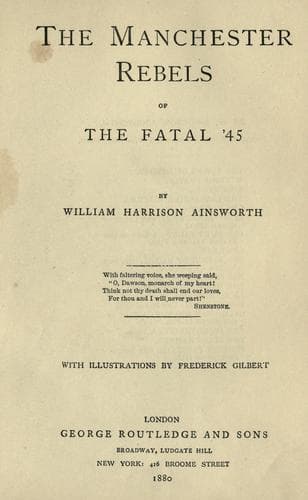
The Manchester Rebels of the Fatal '45Ainsworth, William Harrison
History
The Manchester Rebels of the Fatal '45
Ainsworth, William Harrison
Great Britain -- History -- George II, 1727-1760 -- Fiction; Jacobite Rebellion, 1745-1746 -- Fiction
After the prisoner's evidence had been gone through, the
Solicitor-General declared, "That he felt certain the jury would
consider that the overt acts of high treason charged against the
prisoner in compassing and imagining the death of the king, and in
levying war against his majesty's person and government, had been
sufficiently proved."
While the jury withdrew to consider their verdict, Colonel Townley
looked more indifferent than any other person in court. On their
return, in about ten minutes, the clerk of arraigns said:
"How say you, gentlemen, are you agreed on your verdict? Do you find
Francis Townley guilty of the high treason whereof he stands indicted,
or not guilty?"
"Guilty," replied the foreman.
Sentence of death was then pronounced upon him by Lord Chief Justice
Lee, and during that awful moment he did not betray the slightest
discomposure.
He was then delivered to the care of Mr. Jones, keeper of the county
gaol of Surrey.
Captain Dawson's trial next took place. His youth and good looks
excited general sympathy.
The indictment was similar to that of Colonel Townley--the treason
being alleged to be committed at the same time. The Attorney-General
set forth that the prisoner, contrary to his allegiance, accepted a
commission in the Manchester Regiment raised by Colonel Townley for
the service of the Pretender, and acted as captain; that he marched to
Derby in a hostile manner; that he retreated with the rebel army from
Derby to Manchester, and thence to Clifton Moor, where in a skirmish
he headed his men against the Duke of Cumberland's troops; and that he
had surrendered at the same time as Colonel Townley and the other
officers.
Evidence to the above effect was given by Maddox and other witnesses.
No defence was made by the prisoner, and the jury, without going out
of court, brought him in guilty.
As their verdict was delivered, a convulsive sob was heard, and
attention being directed to the spot whence the sound proceeded, it
was found that a young lady had fainted. As she was carried out the
prisoner's eyes anxiously followed her, and it was soon known that she
was his betrothed.
The rest of the rebel officers were subsequently tried and found
guilty, and sentence of death was passed upon them all.
The order for the execution was couched in the following terms:
"Let the several prisoners herein named return to the gaol of the
county of Surrey whence they came. Thence they must be drawn to the
place of execution, on Kennington Common, and when brought there must
be hanged by the neck--but not till they are dead, for they must be
cut down alive. Then their hearts must be taken out and burnt before
their faces. Their heads must be severed from their bodies, and their
bodies divided into quarters, and these must be at the king's
disposal."
CHAPTER V.
THE NIGHT BEFORE THE EXECUTIONS.
Public-domain text, read in full here on John Shaqi.
Reviews
Reviews
No reviews yet
Be the first to share your thoughts on this work.
Elsewhere in the archive
Join the Discussion
Join the discussion
Sign in to leave a comment or review.
Sign InorCreate an account