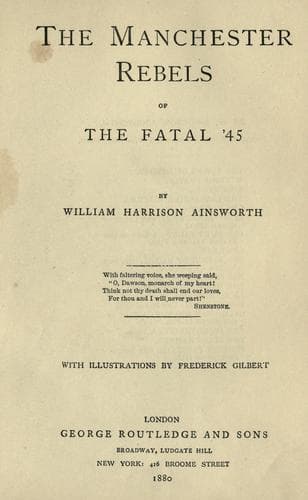
The Manchester Rebels of the Fatal '45Ainsworth, William Harrison
History
The Manchester Rebels of the Fatal '45
Ainsworth, William Harrison
Great Britain -- History -- George II, 1727-1760 -- Fiction; Jacobite Rebellion, 1745-1746 -- Fiction
"Our time draws very near," observed Syddall to Captain Dawson, who
sat next him. "But for my part I feel as hearty as ever I did in my
life. Indeed, I think we all look remarkably well considering our
position."
"Death does not terrify me in the least," said Jemmy. "Its bitterness
is past with me. May Heaven have mercy on us all!"
"We die in a good cause," observed Captain Deacon. "I heartily forgive
all my enemies--even the chief of them, the Elector of Hanover and the
Duke of Cumberland. It has been falsely said that I was induced by my
revered father to take up arms for the prince. The assertion I shall
contradict in the manifesto I have prepared. For the rest I care not
what my enemies say of me."
"The Duke of Cumberland has not kept faith with us," exclaimed Captain
Fletcher. "When we surrendered at Carlisle, he declared that the
garrison should not be put to the sword, but reserved for his father's
pleasure--the Elector's pleasure being that we should be hung, drawn,
and quartered. Gracious Heaven! deliver all Englishmen from this
Hanoverian clemency!"
"My sole regret is that we ever surrendered," cried Colonel Townley.
"Would we all had died sword in hand! However, since we are brought to
this pass, we must meet our fate like brave men. As we have been
allowed wine with our last repast, let us drink to King James the
Third!"
Every glass was raised in response, after which they all rose from the
table.
Several friends of the prisoners were now permitted to enter the room.
Among them were Mr. Saunderson, Colonel Townley's confessor, and
Captain Deacon's youngest brother, Charles.
Charles Deacon had been reprieved; but, while embracing his brother
for the last time, he expressed deep regret that he could not share
his fate.
Poor Monica was there--dressed in deep mourning. She and her lover
were somewhat removed from the rest; but they were so engrossed by
each other, that they seemed to be quite alone.
Their parting attracted the attention of Tom Syddall, and moved him to
tears--though he had shed none for his own misfortunes.
"How did you pass the night, dearest Jemmy?" inquired Monica.
"Chiefly in prayer," he replied. "But towards morn I fell asleep, and
dreamed that you and I were children, and playing together in the
fields. It was a pleasant dream, and I was sorry when I awoke."
"I, too, had a pleasant dream, dearest Jemmy," she rejoined. "I
thought I saw my mother. She had a seraphic aspect, and seemed to
smile upon me. That smile has comforted me greatly. Ha! what sound is
that?"
"'Tis the guard assembling in the court-yard," he replied. "We must
part. Do not give way."
"Fear me not," she cried, throwing her arms around his neck.
At this juncture, the sheriffs entered the room, attended by the
keeper of the prison. The sheriffs wore black gowns, and were without
their chains.
Public-domain text, read in full here on John Shaqi.
Reviews
Reviews
No reviews yet
Be the first to share your thoughts on this work.
Elsewhere in the archive
Join the Discussion
Join the discussion
Sign in to leave a comment or review.
Sign InorCreate an account