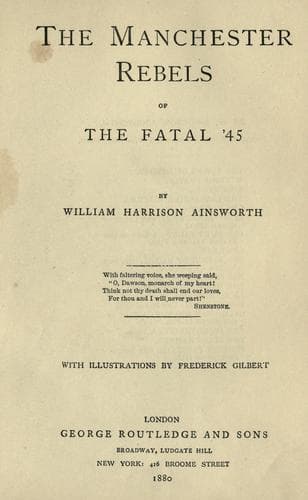
The Manchester Rebels of the Fatal '45Ainsworth, William Harrison
History
The Manchester Rebels of the Fatal '45
Ainsworth, William Harrison
Great Britain -- History -- George II, 1727-1760 -- Fiction; Jacobite Rebellion, 1745-1746 -- Fiction
While the sheriffs were exchanging a few words with Colonel Townley
and the other prisoners, Mr. Jones conducted Monica to the
mourning-coach which was waiting for her at the gates of the prison.
Meanwhile, a guard of grenadiers had been drawn up in the court-yard,
and the ignominious conveyances, destined to take the prisoners to the
place of execution, had been got ready.
By-and-by, the unfortunate men were brought down, and in the presence
of the sheriffs and the keeper of the prison were bound to the hurdles
with cords.
This done, the dismal procession set forth.
At the head of the train marched a party of grenadiers. Then followed
the sheriffs in their carriages, with their tipstaves walking beside
them.
Those about to suffer came next. On the foremost hurdle were stretched
Colonel Townley, Captain Deacon, and Jemmy Dawson. The remaining
prisoners were bound in like manner. Another party of grenadiers
followed.
Next came several hearses, containing coffins, destined for the
mangled bodies of the victims.
After the hearses followed a number of mourning-coaches, drawn by
horses decked with trappings of woe. In the foremost of these coaches
sat Monica, with her attendant, Lettice.
In this order the gloomy procession shaped its course slowly towards
the place of execution. The streets were crowded with spectators
anxious to obtain a sight of the unfortunate men who were dragged in
this ignominious manner along the rough pavement. But no groans were
uttered--no missiles thrown. On the contrary, much commiseration was
manifested by the crowd, especially when the mourning-coaches were
seen, and great curiosity was exhibited to obtain a sight of their
occupants. For Monica, whose story had become known, unwonted sympathy
was displayed.
At length, the train drew near Kennington Common, where a large
assemblage was collected to witness the dreadful scene. Hitherto, the
crowd had been noisy, but it now became suddenly quiet. In the centre
of the common, which of late years has been enclosed, and laid out as
a park, a lofty gibbet was reared. Near it was placed a huge block,
and close to the latter was a great pile of faggots. On the block were
laid an executioner's knife and one or two other butcherly
instruments.
At the foot of the fatal tree stood the executioner--a
villainous-looking catiff--with two assistants quite as repulsive in
appearance as himself. The two latter wore leather vests, and their
arms were bared to the shoulder.
On the arrival of the train at the place of execution, the sheriffs
alighted, and the grenadiers formed a large circle round the gibbet.
The prisoners were then released from the hurdles, but their limbs
were so stiffened by the bonds that they could scarcely move.
At the same time the faggots were lighted, and a flame quickly arose,
giving a yet more terrible character to the scene.
Public-domain text, read in full here on John Shaqi.
Reviews
Reviews
No reviews yet
Be the first to share your thoughts on this work.
Elsewhere in the archive
Join the Discussion
Join the discussion
Sign in to leave a comment or review.
Sign InorCreate an account