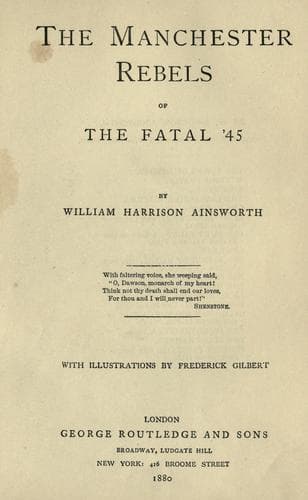
The Manchester Rebels of the Fatal '45Ainsworth, William Harrison
History
The Manchester Rebels of the Fatal '45
Ainsworth, William Harrison
Great Britain -- History -- George II, 1727-1760 -- Fiction; Jacobite Rebellion, 1745-1746 -- Fiction
To the bystanders, who were astounded at his seeming unconcern, he
said:
"Why should I mourn for my son? He has died the death of a martyr."
He then took off his hat, and bowing reverently to the two heads,
departed.
But he never came near the Exchange without repeating the ceremony,
and many other inhabitants of the town followed his example.
CHAPTER VII.
FIVE YEARS LATER.
Once more, and at a somewhat later date, we shall revisit Rawcliffe
Hall.
It still wears an antique aspect, but has a far more cheerful look
than of yore. Internally many alterations have been made, which may be
safely described as improvements. All the disused apartments have been
thrown open, and re-furnished. That part of the mansion in which the
tragic event we have recounted took place has been pulled down and
rebuilt, and the secret entry to the library no longer exists.
Everything gloomy and ghostly has disappeared.
Father Jerome no longer darkens the place with his presence, but
before his departure he was compelled to give up all the documents he
had abstracted. A large establishment is kept up, at the head of which
is worthy old Markland.
Sir Conway Rawcliffe has long been in possession of the estates and
title. Moreover, he is wedded to the loveliest woman in Cheshire, and
their union has been blessed by a son. It is pleasant to see the young
baronet in his own house. He has become quite a country gentleman--is
fond of all country sports, hunts, shoots, and occupies himself with
planting trees in his park, and generally improving his property. So
enamoured is he of a country life, so happy at Rawcliffe, that his
wife cannot induce him to take a house in town for the spring. His
uncle, Colonel Conway, wished him to join the army, but he declined.
He avoids all dangerous politics, and is well affected towards the
Government.
Lady Rawcliffe is likewise fond of the country, though she would
willingly spend a few months in town, now and then, as we have
intimated. She looks lovelier than ever. Five years have improved her.
Her figure is fuller, bloom has returned to her cheeks, and the
melancholy that hung upon her brow has wholly disappeared. Need we say
that her husband adores her, and deems himself--and with good
reason--the happiest and luckiest of men?
They often talk of Monica and Jemmy Dawson. Time has assuaged their
grief, but Constance never thinks of the ill-fated lovers without a
sigh. Poor Monica sleeps peacefully beside her mother in the family
vault.
Public-domain text, read in full here on John Shaqi.
Reviews
Reviews
No reviews yet
Be the first to share your thoughts on this work.
Elsewhere in the archive
Join the Discussion
Join the discussion
Sign in to leave a comment or review.
Sign InorCreate an account