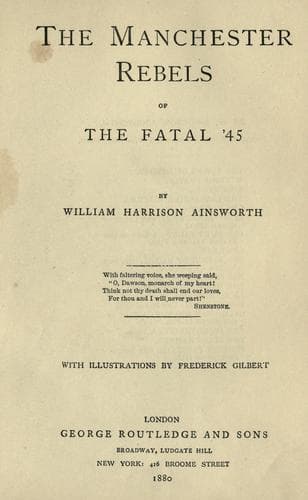
The Manchester Rebels of the Fatal '45Ainsworth, William Harrison
History
The Manchester Rebels of the Fatal '45
Ainsworth, William Harrison
Great Britain -- History -- George II, 1727-1760 -- Fiction; Jacobite Rebellion, 1745-1746 -- Fiction
Sir Conway and Lady Rawcliffe frequently pass a day at Manchester with
the Byroms. The closest friendship subsists between them and that
amiable family. Wonderful to relate, Beppy is still unmarried. That
she continues single is clearly her own fault, for she has had plenty
of offers, not merely from young churchmen, but from persons of wealth
and good position. But she would have none of them. Possibly, she may
have had some disappointment, but if so it has not soured her
singularly sweet temper, or affected her spirits, for she is just as
lively and bewitching as ever. She is a frequent visitor at Rawcliffe
Hall.
Dr. Deacon is much changed, but if he mourns for his sons it is in
private. After a long imprisonment, his youngest son Charles has been
sent into exile.
A word in reference to the unfortunate Parson Coppock. He was
imprisoned in Carlisle Castle with the other non-commissioned officers
of the Manchester Regiment, and brought to the scaffold.
For many months after the suppression of the rebellion the magistrates
of Manchester held constant meetings at a room in the little street,
most appropriately called Dangerous Corner, to compel all suspected
persons to take oaths to the Government, and abjure Popery and the
Pretender.
Denounced by some of his brother magistrates, and charged by them with
aiding and abetting the cause of the rebels, Mr. Fowden, the
constable, was tried for high treason at Lancaster, but honourably
acquitted.
On his return the worthy gentleman was met by a large party of friends
on horseback, and triumphantly escorted to his own house.
After being exposed for some time on the Exchange, the heads of poor
Theodore Deacon and Tom Syddall were carried away one night--perhaps
by the contrivance of the doctor--and secretly buried.
Though disheartened by recent events, the Jacobites still continued in
force in Manchester. They greatly rejoiced at the escape of the young
Chevalier to France, after his wanderings in the Highlands, and the
more hopeful of the party predicted that another invasion would soon
be made, and frequently discussed it at the meetings of their club at
the Bull's Head.
At length, a general amnesty was proclaimed, and several noted
Jacobites, compromised by the part they had taken in the rebellion,
reappeared in the town.
Amongst them was the Rev. Mr. Clayton, who was reinstated as chaplain
of the collegiate church.
Long afterwards, whenever allusion was made at a Jacobite meeting to
the eventful year of our story, it was designated the "fatal
'Forty-Five."
A sad period no doubt. Yet some ancient chroniclers of the town, who
have long disappeared from the scene, but to whom we listened
delightedly in boyhood, were wont to speak of the prince's visit to
Manchester as occurring in the Good Old Times.
The Good Old Times!--all times are good when old!
THE END.
LONDON:
WHITING AND COMPANY, LIMITED, SARDINIA STREET, LINCOLN'S-INN-FIELDS.
Public-domain text, read in full here on John Shaqi.
Reviews
Reviews
No reviews yet
Be the first to share your thoughts on this work.
Elsewhere in the archive
Join the Discussion
Join the discussion
Sign in to leave a comment or review.
Sign InorCreate an account