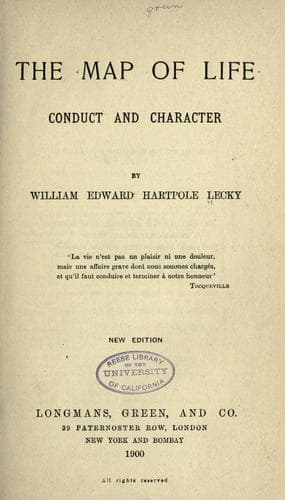
The Map of Life: Conduct and CharacterLecky, William Edward Hartpole
Philosophy
The Map of Life: Conduct and Character
Lecky, William Edward Hartpole
Character; Conduct of life
I have dwelt on the difficult questions which arise when the wishes of
his constituents are at variance with his own genuine opinions. Another
and a wider question is how far he is bound to make what he considers
the interests of the nation his guiding light, and how far he should
subordinate what he believes to be their interests to their prejudices
and wishes. One of the first lessons that every active politician has to
learn is that he is a trustee bound to act for men whose opinions,
aims, desires and ideals are often very different from his own. No man
who holds the position of member of Parliament should divest himself of
this consideration, though it applies to different classes of members in
different degrees. A private member should not forget it, but at the
same time, being elected primarily and specially to represent one
particular element in the national life, he will concentrate his
attention more exclusively on a narrow circle, though he has at the same
time more latitude of expressing unpopular opinions and pushing unripe
and unpopular causes than a member who is taking a large and official
part in the government of the nation. The opposition front bench
occupies a somewhat different position. They are the special and
organised representatives of a particular party and its ideas, but the
fact that they may be called upon at any time to undertake the
government of the nation as a whole, and that even while in opposition
they take a great part in moulding its general policy, imposes on them
limitations and restrictions from which a mere private member is in a
great degree exempt. When a party comes into power its position is again
slightly altered. Its leaders are certainly not detached from the party
policy they had advocated in opposition. One of the main objects of
party is to incorporate certain political opinions and the interests of
certain sections of the community in an organised body which will be a
steady and permanent force in politics. It is by this means that
political opinions are most likely to triumph; that class interests are
most effectually protected. But a Government cannot govern merely in the
interests of a party. It is a trustee for the whole nation, and one of
its first duties is to ascertain and respect as far as possible the
wishes as well as the interests of all sections.
Public-domain text, read in full here on John Shaqi.
Reviews
Reviews
No reviews yet
Be the first to share your thoughts on this work.
Elsewhere in the archive
Join the Discussion
Join the discussion
Sign in to leave a comment or review.
Sign InorCreate an account