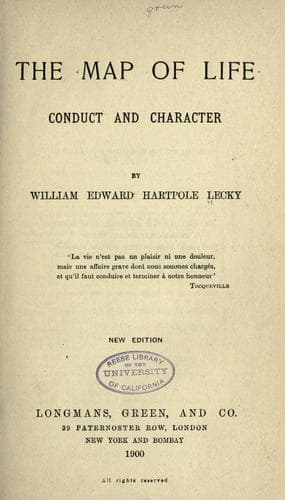
The Map of Life: Conduct and CharacterLecky, William Edward Hartpole
Philosophy
The Map of Life: Conduct and Character
Lecky, William Edward Hartpole
Character; Conduct of life
One of the worst moral evils that grow up in democratic countries is the
excessive tendency to time-serving and popularity hunting, and the
danger is all the greater because in a certain sense both of these
things are a necessity and even a duty. Their moral quality depends
mainly on their motive. The question to be asked is whether a politician
is acting from personal or merely party objects or from honourable
public ones. Every statesman must form in his own mind a conception
whether a prevailing tendency is favourable or opposed to the real
interests of the country. It will depend upon this judgment whether he
will endeavour to accelerate or retard it; whether he will yield slowly
or readily to its pressure, and there are cases in which, at all hazards
of popularity and influence, he should inexorably oppose it. But in the
long run, under free governments, political systems and measures must be
adjusted to the wishes of the various sections of the people, and this
adjustment is the great work of statesmanship. In judging a proposed
measure a statesman must continually ask himself whether the country is
ripe for it--whether its introduction, however desirable it might be,
would not be premature, as public opinion is not yet prepared for
it?--whether, even though it be a bad measure, it is not on the whole
better to vote for it, as the nation manifestly desires it?
The same kind of reasoning applies to the difficult question of
education, and especially of religious education. Every one who is
interested in the subject has his own conviction about the kind of
education which is in itself the best for the people, and also the best
for the Government to undertake. He may prefer that the State should
confine itself to purely secular education, leaving all religious
teaching to voluntary agencies; or he may approve of the kind of
undenominational religious teaching of the English School Board; or he
may be a strong partisan of one of the many forms of distinctly
accentuated denominational education. But when he comes to act as a
responsible legislator, he should feel that the question is not merely
what _he_ considers the best, but also what the parents of the children
most desire. It is true that the authority of parents is not absolutely
recognised. The conviction that certain things are essential to the
children, and to the well-being and vigour of the State, and the
conviction that parents are often by no means the best judges of this,
make legislators, on some important subjects, override the wishes of the
parents. The severe restrictions imposed on child labour; the
measure--unhappily now greatly relaxed--providing for children's
vaccination; and the legislation protecting children from ill treatment
by their parents, are illustrations, and the most extensive and
far-reaching of all exceptions is education. After much misgiving, both
parties in the State have arrived at the conclusion that it is essential
Public-domain text, read in full here on John Shaqi.
Reviews
Reviews
No reviews yet
Be the first to share your thoughts on this work.
Elsewhere in the archive
Join the Discussion
Join the discussion
Sign in to leave a comment or review.
Sign InorCreate an account