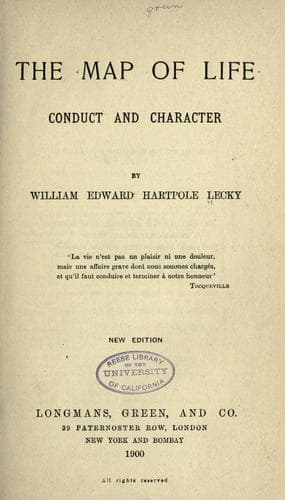
The Map of Life: Conduct and CharacterLecky, William Edward Hartpole
Philosophy
The Map of Life: Conduct and Character
Lecky, William Edward Hartpole
Character; Conduct of life
Another case which in a party point of view was more successful, but
which should in my opinion be much more severely judged, was the Reform
Bill of 1867. The Conservative party, under the guidance of Mr.
Disraeli, defeated Mr. Gladstone's Reform Bill mainly on the ground that
it was an excessive step in the direction of Democracy. The victory
placed them in office, and they then declared that, as the question had
been raised, they must deal with it themselves. They introduced a bill
carrying the suffrage to a much lower point than that which the late
Government had proposed, but they surrounded it with a number of
provisions securing additional representation for particular classes and
interests which would have materially modified its democratic
character.
But for these safeguarding provisions the party would certainly not have
tolerated the introduction of such a measure, yet in the face of
opposition their leader dropped them one by one as of no capital
importance, and, by a leadership which was a masterpiece of unscrupulous
adroitness, succeeded in inducing his party to carry a measure far more
democratic than that which they had a few months before denounced and
defeated. It was argued that the question must be settled; that it must
be placed on a permanent and lasting basis; that it must no longer be
suffered to be a weapon in the hands of the Whigs, and that the Tory
Reform Bill, though it was acknowledged to be a 'leap in the dark,' had
at least the result of 'dishing the Whigs.' There is little doubt that
it was in accordance with the genuine convictions of Disraeli. He
belonged to a school of politics of which Bolingbroke, Carteret and
Shelburne, and, in some periods of his career, Chatham, were earlier
representatives who had no real sympathy with the preponderance of the
aristocratic element in the old Tory party, who had a decided
disposition to appeal frankly to democratic support, and who believed
that a strong executive resting on a broad democratic basis was the true
future of Toryism. He anticipated to a remarkable degree the school of
political thought which has triumphed in our own day, though he did not
live to witness its triumph. At the same time it cannot be denied that
the Reform Bill of 1867 in the form in which it was ultimately carried
was as far as possible from the wishes and policy of his party in the
beginning of the session, and as inconsistent as any policy could be
with their language and conduct in the session that preceded it.
Public-domain text, read in full here on John Shaqi.
Reviews
Reviews
No reviews yet
Be the first to share your thoughts on this work.
Elsewhere in the archive
Join the Discussion
Join the discussion
Sign in to leave a comment or review.
Sign InorCreate an account