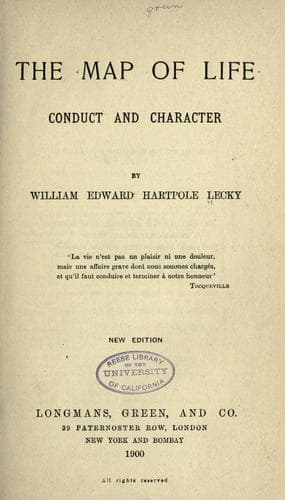
The Map of Life: Conduct and CharacterLecky, William Edward Hartpole
Philosophy
The Map of Life: Conduct and Character
Lecky, William Edward Hartpole
Character; Conduct of life
A parliamentary government chosen on the party system is, as we have
seen, at once the trustee of the whole nation, bound as such to make the
welfare of the whole its supreme end, and also the special
representative of particular classes, the special guardian of their
interests, aims, wishes, and principles. The two points of view are not
the same, and grave difficulties, both ethical and political, have often
to be encountered in endeavouring to harmonise them. It is, of course,
not true that a party object is merely a matter of place or power, and
naturally a different thing from a patriotic object. The very meaning of
party is that public men consider certain principles of government,
certain lines of policy, the protection and development of particular
interests, of capital importance to the nation, and they are therefore
on purely public grounds fully justified in making it a main object to
place the government of the country in the hands of their party. The
importance, however, of maintaining a particular party in power varies
greatly. In many, probably in most, periods of English history a change
of government means no violent or far-reaching alteration in policy. It
means only that one set of tendencies in legislation will for a time be
somewhat relaxed, and another set somewhat intensified; that the
interests of one class will be somewhat more and those of another class
somewhat less attended to; that the rate of progress or change will be
slightly accelerated or retarded. Sometimes it means even less than
this. Opinions on the two front benches are so nearly assimilated that
a change of government principally means the removal for a time from
office of ministers who have made some isolated administrative blunders
or incurred some individual unpopularity quite apart from their party
politics. It means that ministers who are jaded and somewhat worn out by
several years' continuous work, and of whom the country had grown tired,
are replaced by men who can bring fresher minds and energies to the
task; that patronage in all its branches having for some years gone
mainly to one party, the other party are now to have their turn. There
are periods when the country is well satisfied with the general policy
of a government but not with the men who carry it on. Ministers of
excellent principles prove inefficient, tactless, or unfortunate, or
quarrels and jealousies arise among them, or difficult negotiations are
going on with foreign nations which can be best brought to a successful
termination if they are placed in the hands of fresh men, unpledged and
unentangled by their past. The country wants a change of government but
not a change of policy, and under such circumstances the task of a
victorious opposition is much less to march in new directions than to
mark time, to carry on the affairs of the nation on the same lines, but
with greater administrative skill. In such periods the importance of
Public-domain text, read in full here on John Shaqi.
Reviews
Reviews
No reviews yet
Be the first to share your thoughts on this work.
Elsewhere in the archive
Join the Discussion
Join the discussion
Sign in to leave a comment or review.
Sign InorCreate an account