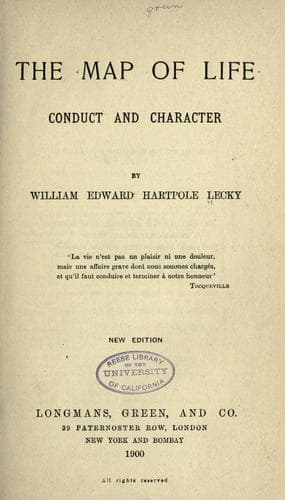
The Map of Life: Conduct and CharacterLecky, William Edward Hartpole
Philosophy
The Map of Life: Conduct and Character
Lecky, William Edward Hartpole
Character; Conduct of life
When one party has introduced a measure of this kind the other is under
the strongest temptation to outbid it, and under the stress of
competition and through the fear of being distanced in the race of
popularity both parties often end by going much further than either had
originally intended. When the rights of the few are opposed to the
interests of the many there is a constant tendency to prefer the latter.
It may be that the few are those who have built up an industry; who have
borne all the risk and cost, who have by far the largest interest in its
success. The mere fact that they are the few determines the bias of the
legislators. There is a constant disposition to tamper with even clearly
defined and guaranteed rights if by doing so some large class of voters
can be conciliated.
Parliamentary life has many merits, but it has a manifest tendency to
encourage short views. The immediate party interest becomes so absorbing
that men find it difficult to look greatly beyond it. The desire of a
skilful debater to use the topics that will most influence the audience
before him, or the desire of a party leader to pursue the course most
likely to be successful in an immediately impending contest, will often
override all other considerations, and the whole tendency of
parliamentary life is to concentrate attention on landmarks which are
not very distant, thinking little of what is beyond.
One great cause of the inconsistency of parties lies in the absolute
necessity of assimilating legislation. Many, for example, are of opinion
that the existing tendency to introduce government regulations and
interferences into all departments is at least greatly exaggerated, and
that it would be far better if a larger sphere were left to individual
action and free contract. But if large departments of industry have been
brought under the system of regulation, it is practically impossible to
leave analogous industries under a different system, and the men who
most dislike the tendency are often themselves obliged to extend it.
They cannot resist the contention that certain legislative protections
or other special favours have been granted to one class of workmen, and
that there is no real ground for distinguishing their case from that of
others. The dominant tendency will thus naturally extend itself, and
every considerable legislative movement carries others irresistibly in
its train.
Public-domain text, read in full here on John Shaqi.
Reviews
Reviews
No reviews yet
Be the first to share your thoughts on this work.
Elsewhere in the archive
Join the Discussion
Join the discussion
Sign in to leave a comment or review.
Sign InorCreate an account