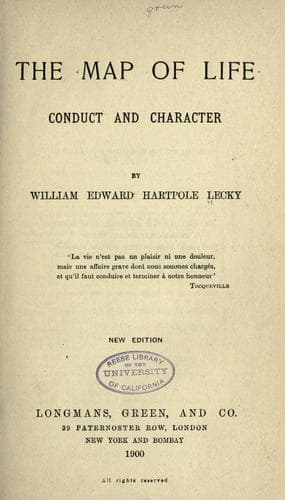
The Map of Life: Conduct and CharacterLecky, William Edward Hartpole
Philosophy
The Map of Life: Conduct and Character
Lecky, William Edward Hartpole
Character; Conduct of life
The pressure of this consideration is most painfully felt in the case of
legislation which appears not simply inexpedient and unwise, but
distinctly dishonest. In legislation relating to contracts there is a
clear ethical distinction to be drawn. It is fully within the moral
right of legislators to regulate the conditions of future contracts. It
is a very different thing to break existing contracts, or to take the
still more extreme step of altering their conditions to the benefit of
one party without the assent of the other, leaving that other party
bound by their restrictions.
In the American Constitution there is a special clause making it
impossible for any State to pass any law violating contracts. In
England, unfortunately, no such provision exists. The most glaring and
undoubted instance of this kind is to be found in the Irish land
legislation which was begun by the Ministry of Mr. Gladstone, but which
has been largely extended by the party that originally most strenuously
opposed it. Much may no doubt be said to palliate it: agricultural
depression; the excessive demand for land; the fact that improvements
were in Ireland usually made by the tenants (who, however, were
perfectly aware of the conditions under which they made them, and whose
rents were proportionately lower); the prevalence in some parts of
Ireland of land customs unsanctioned by law; the existence of a great
revolutionary movement which had brought the country into a condition of
disgraceful anarchy. But when all this has been admitted, it remains
indisputable to every clear and honest mind that English law has taken
away without compensation unquestionably legal property and broken
unquestionably legal contracts. A landlord placed a tenant on his farm
on a yearly tenancy, but if he desired to exercise his plain legal right
of resuming it at the termination of the year, he was compelled to pay a
compensation 'for disturbance,' which might amount to seven times the
yearly rent. A landlord let his land to a farmer for a longer period
under a clear written contract bearing the government stamp, and this
contract defined the rent to be paid, the conditions under which the
farm was to be held, and the number of years during which it was to be
alienated from its owner. The fundamental clause of the lease distinctly
stipulated that at the end of the assigned term the tenant must hand
back that farm to the owner from whom he received it. The law has
interposed, and determined that the rent which this farmer had
undertaken to pay shall be reduced by a government tribunal without the
assent of the owner, and without giving the owner the option of
dissolving the contract and seeking a new tenant. It has gone further,
and provided that at the termination of the lease the tenant shall not
hand back the land to the owner according to the terms of his contract,
but shall remain for all future time the occupier, subject only to a
Public-domain text, read in full here on John Shaqi.
Reviews
Reviews
No reviews yet
Be the first to share your thoughts on this work.
Elsewhere in the archive
Join the Discussion
Join the discussion
Sign in to leave a comment or review.
Sign InorCreate an account