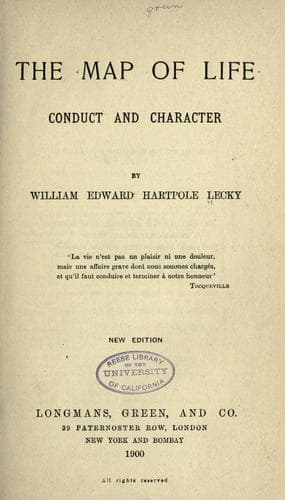
The Map of Life: Conduct and CharacterLecky, William Edward Hartpole
Philosophy
The Map of Life: Conduct and Character
Lecky, William Edward Hartpole
Character; Conduct of life
rent fixed and periodically revised, irrespective of the wishes of the
landlord, by an independent tribunal. Vast masses of property in Ireland
had been sold under the Incumbered Estates Act by a government tribunal
acting as the representative of the Imperial Parliament, and each
purchaser obtained from this tribunal a parliamentary title making him
absolute owner of the soil and of every building upon it, subject only
to the existing tenancies in the schedule. No accounts of the earlier
history of the property were handed to him, for except under the terms
of the leases which had not yet expired he had no liability for anything
in the past. The title he received was deemed so indefeasible that in
one memorable case, where by mistake a portion of the property of one
man had been included in the sale of the property of another man, the
Court of Appeal decided that the injustice could not be remedied, as it
was impossible, except in the case of intentional fraud, to go behind
parliamentary titles.[44] In cases in which the land was let at low
rents, and in cases where tenants held under leases which would soon
expire, the facility of raising the rents was constantly specified by
the authority of the Court as an inducement to purchasers.
What has become of this parliamentary title? Improvements, if they had
been made, or were presumed to have been made by tenants anterior to the
sale, have ceased to be the property of the purchaser, and he has at the
same time been deprived of some of the plainest and most inseparable
rights of property. He has lost the power of disposing of his farms in
the open market, of regulating the terms and conditions on which he lets
them, of removing a tenant whom he considers unsuitable, of taking the
land back into his own hands when the specified term of a tenancy had
expired, of availing himself of the enhanced value which a war or a
period of great prosperity, or some other exceptional circumstance, may
have given to his property. He has become a simple rent-charger on the
land which by inheritance or purchase was incontestably his own, and the
amount of his rent-charge is settled and periodically revised by a
tribunal in which he has no voice, and which has been given an absolute
power over his estate. He bought or inherited an exclusive right. The
law has turned it into a dual ownership. A tenant right which, when he
obtained his property, was wholly unknown to the law, and was only
generally recognised by custom in one province, has been carved out of
it. The tenant who happened to be in occupation when the law was passed
can, without the consent of the owner, sell to another the right of
occupying the farm at the existing rent. In numerous cases this tenant
right is more valuable than the fee simple of the farm. In many cases a
farmer who had eagerly begged to be a tenant at a specified rent has
afterwards gone into the land court and had that rent reduced, and has
Public-domain text, read in full here on John Shaqi.
Reviews
Reviews
No reviews yet
Be the first to share your thoughts on this work.
Elsewhere in the archive
Join the Discussion
Join the discussion
Sign in to leave a comment or review.
Sign InorCreate an account