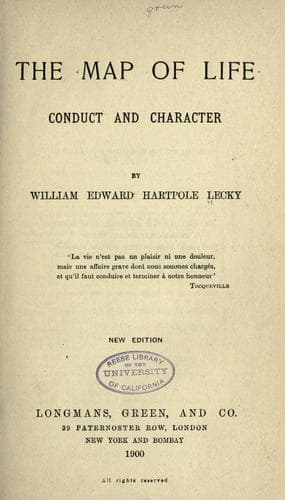
The Map of Life: Conduct and CharacterLecky, William Edward Hartpole
Philosophy
The Map of Life: Conduct and Character
Lecky, William Edward Hartpole
Character; Conduct of life
There are other temptations of a different kind with which party leaders
have to deal. One of the most serious is the tendency to force questions
for which there is no genuine desire, in order to restore the unity or
the zeal of a divided or dispirited party. As all politicians know, the
desire for an attractive programme and a popular election cry is one of
the strongest in politics, and, as they also know well, there is such a
thing as manufactured public opinion and artificially stimulated
agitation. Questions are raised and pushed, not because they are for the
advantage of the country, but simply for the purposes of party. The
leaders have often little or no power of resistance. The pressure of
their followers, or of a section of their followers, becomes
irresistible; ill-considered hopes are held out; rash pledges are
extorted, and the party as a whole is committed. Much premature and
mischievous legislation may be traced to such causes.
Another very difficult question is the manner in which governments
should deal with the acts of public servants which are intended for the
public service, but which in some of their parts are morally
indefensible. Very few of the great acquisitions of nations have been
made by means that were absolutely blameless, and in a great empire
which has to deal with uncivilised or semi-civilised populations acts of
violence are certain to be not infrequent. Neither in our judgments of
history nor in our judgments of contemporaries is it possible to apply
the full stringency of private morals to the cases of men acting in
posts of great responsibility and danger amid the storms of revolution,
or panic, or civil war. With the vast interests confided to their care,
and the terrible dangers that surround them, measures must often be
taken which cannot be wholly or at least legally justified. On the other
hand, men in such circumstances are only too ready to accept the
principle of Macchiavelli and of Napoleon, and to treat politics as if
they had absolutely no connection with morals.
Cases of this kind must be considered separately and with a careful
examination of the motives of the actor and of the magnitude of the
dangers he had to encounter. Allowances must be made for the moral
atmosphere in which he moved, and his career must be considered as a
whole, and not only in its peccant parts. In the trial of Warren
Hastings, and in the judgments which historians have passed on the
lives of the other great adventurers who have built up the Empire,
questions of this kind continually arise.
Public-domain text, read in full here on John Shaqi.
Reviews
Reviews
No reviews yet
Be the first to share your thoughts on this work.
Elsewhere in the archive
Join the Discussion
Join the discussion
Sign in to leave a comment or review.
Sign InorCreate an account