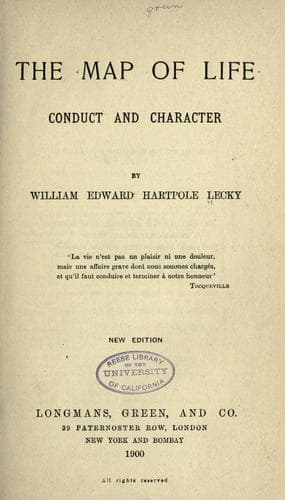
The Map of Life: Conduct and CharacterLecky, William Edward Hartpole
Philosophy
The Map of Life: Conduct and Character
Lecky, William Edward Hartpole
Character; Conduct of life
In our own day also they have been very frequent. The _Coup d'état_ of
the 2nd of December, 1851, is an extreme example. Louis Napoleon had
sworn to observe and to defend the Constitution of the French Republic,
which had been established in 1848, and that Constitution, among other
articles, pronounced the persons of the representatives of the people to
be inviolable; declared every act of the President which dissolved the
Assembly or prorogued it, or in any way trammelled it in the exercise of
its functions, to be high treason, and guaranteed the fullest liberty of
writing and discussion. 'The oath which I have just taken,' said the
President, addressing the Assembly, 'commands my future conduct. My duty
is clear; I will fulfil it as a man of honour. I shall regard as enemies
of the country all those who endeavour to change by illegal means what
all France has established.' In more than one subsequent speech he
reiterated the same sentiments and endeavoured to persuade the country
that under no possible circumstances would he break his oath or violate
his conscience, or overstep the limits of his constitutional powers.
What he did is well known. Before daybreak on December 2, some of the
most eminent statesmen in France, including eighteen members of the
Chamber, were, by his orders, arrested in their beds and sent to prison,
and many of them afterwards to exile. The Chamber was occupied by
soldiers, and its members, who assembled in another place, were marched
to prison. The High Court of Justice was dissolved by force. Martial
law was proclaimed. Orders were given that all who resisted the
usurpation in the streets were at once, and without trial, to be shot.
All liberty of the press, all liberty of public meeting or discussion,
were absolutely destroyed. About one hundred newspapers were suppressed
and great numbers of their editors transported to Cayenne. Nothing was
allowed to be published without Government authority. In order to
deceive the people as to the amount of support behind the President, a
'Consultative Commission' was announced and the names were placarded in
Paris. Fully half the persons whose names were placed on this list
refused to serve, but in spite of their protests their names were kept
there in order that they might appear to have approved of what was
done.[45] Orders were issued immediately after the _Coup d'état_ that
every public functionary who did not instantly give in writing his
adhesion to the new Government should be dismissed. The Préfets were
given the right to arrest in their departments whoever they pleased. By
an _ex post facto_ decree, issued on December 8, the Executive were
enabled without trial to send to Cayenne, or to the penal settlements in
Africa, any persons who had in any past time belonged to a 'secret
society,' and this order placed all the numerous members of political
clubs at the mercy of the Government. Parliament, when it was suffered
Public-domain text, read in full here on John Shaqi.
Reviews
Reviews
No reviews yet
Be the first to share your thoughts on this work.
Elsewhere in the archive
Join the Discussion
Join the discussion
Sign in to leave a comment or review.
Sign InorCreate an account