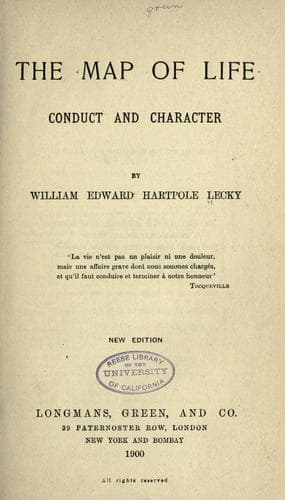
The Map of Life: Conduct and CharacterLecky, William Edward Hartpole
Philosophy
The Map of Life: Conduct and Character
Lecky, William Edward Hartpole
Character; Conduct of life
leading members, and it added seriously to the unpopularity of the
Assembly, and greatly lowered its authority in contending with a
President whose authority rested on direct universal suffrage. More than
once he exercised his power of dismissing and appointing ministries
absolutely irrespective of its votes and wishes, and in each case in
order to fill all posts of power with creatures of his own. The
newspapers supporting him continually inveighed against the Chamber, and
dwelt upon the danger of anarchy to which France would be exposed in
1852 and upon the absolute necessity of 'a Saviour of Society.' In
repeated journeys through France, and in more than one military review,
the President gave the occasion of demonstrations in which the cries of
'Vive l'Empereur!' were often heard, and which were manifestly intended
to strengthen him in his conflict with the Chamber.
The man from whom he had most to fear was Changarnier, who since the
close of 1848 had been commander of the troops in Paris, and whose name,
though far less popular than that of Napoleon, had much weight with the
army. He was a man with strong leanings to authority, and was much
courted by the monarchical parties, but was for some time in decided
sympathy with Napoleon, from whom, however, in spite of large offers
that had been made him, he gradually diverged. He issued peremptory
orders to the troops under his command, forbidding all party cries at
reviews. He declared in the Chamber that these cries had been 'not only
encouraged but provoked,' and when the intention of the President to
prolong his presidency became apparent, he assured Odilon Barrot that he
was prepared, if ordered by the minister and authorised by the President
of the Chamber, to anticipate the _Coup d'état_ by seizing and
imprisoning Louis Napoleon.[49] The President succeeded in removing him
from his command, and in placing a creature of his own at the head of
the Paris troops; but though Changarnier acquiesced without resistance
in his dismissal, he remained an important member of the Assembly; he
openly declared that his sword was at its service, and if an armed
conflict broke out it was tolerably certain that he would be its
representative. The President had an official salary of 48,000
_l_.--nearly five times as much as the President of the United States.
The Chamber refused to increase it, though they consented by a very
small majority, and at the request of Changarnier, to pay his debts.
Public-domain text, read in full here on John Shaqi.
Reviews
Reviews
No reviews yet
Be the first to share your thoughts on this work.
Elsewhere in the archive
Join the Discussion
Join the discussion
Sign in to leave a comment or review.
Sign InorCreate an account