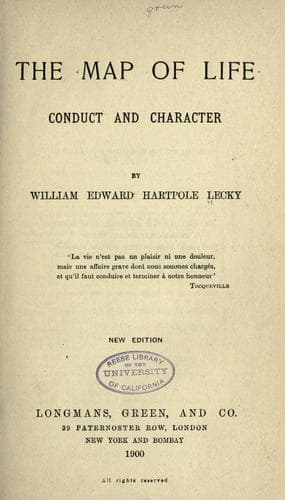
The Map of Life: Conduct and CharacterLecky, William Edward Hartpole
Philosophy
The Map of Life: Conduct and Character
Lecky, William Edward Hartpole
Character; Conduct of life
Like many, however, of the great crimes of history, this was not without
its palliations, and a more detailed investigation will show that those
palliations were not inconsiderable. Napoleon had been elected to the
presidency by 5,434,226 votes out of 7,317,344 which were given, and
with his name, his antecedents, and his well-known aspirations, this
overwhelming majority clearly showed what were the real wishes of the
people. His power rested on universal suffrage; it was independent of
the Chamber. It gave him the direction of the army, though he could not
command it in person, and from the very beginning he assumed an
independent and almost regal position. In the first review that took
place after his election he was greeted by the soldiers with cries of
'Vive Napoléon! Vive l'Empereur!' It was soon proved that the
Constitution of 1848 was exceedingly unworkable. In the words of Lord
Palmerston: 'There were two great powers, each deriving its existence
from the same source, almost sure to disagree, but with no umpire to
decide between them, and neither able by any legal means to get rid of
the other.' The President could not dissolve the Chamber, but he could
impose upon it any ministry he chose. He was himself elected for only
four years, and he could not be re-elected, while by a most fatuous
provision the powers of the President and the Chamber were to expire in
1852 at the same time, leaving France without a government and exposed
to the gravest danger of anarchy.
The Legislative Assembly, which was elected in May, 1849, was, it is
true, far from being a revolutionary one. It contained a minority of
desperate Socialists, it was broken into many factions, and like most
democratic French Chambers it showed much weakness and inconsistency;
but the vast majority of its members were Conservatives who had no kind
of sympathy with revolution, and its conduct towards the President, if
fairly judged, was on the whole very moderate. He soon treated it with
contempt, and it was quite evident that there was no national enthusiasm
behind it. The Socialist party was growing rapidly in the great towns;
in June, 1849, there was an abortive Socialist insurrection in Paris,
and a somewhat more formidable one at Lyons. They were easily put down,
but the Socialists captured a great part of the representation of Paris,
and they succeeded in producing a wild panic throughout the country. It
led to several reactionary measures, the most important being a law
which by imposing new conditions of residence very considerably limited
the suffrage. This law was presented to the Chamber by the Ministers of
the President and with his assent, though he subsequently demanded the
reestablishment of universal suffrage, and made a decree effecting this
one of the chief justifications of his _Coup d'état_. The restrictive
law was carried through the Chamber on May 31, 1850, by an immense
majority, but it was denounced with great eloquence by some of its
Public-domain text, read in full here on John Shaqi.
Reviews
Reviews
No reviews yet
Be the first to share your thoughts on this work.
Elsewhere in the archive
Join the Discussion
Join the discussion
Sign in to leave a comment or review.
Sign InorCreate an account