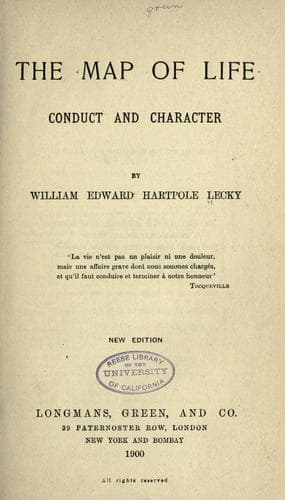
The Map of Life: Conduct and CharacterLecky, William Edward Hartpole
Philosophy
The Map of Life: Conduct and Character
Lecky, William Edward Hartpole
Character; Conduct of life
The President had now fully resolved upon a _Coup d'état_, and before
the Chamber reassembled a new ministry was constituted, St.-Arnaud being
at the head of the army, and Maupas at the head of the police. His first
step was to summon the Chamber to repeal the law of May 31 which
abolished universal suffrage. The Chamber, after much hesitation,
refused, but only by two votes. The belief that the question could only
be solved by force was becoming universal, and the bolder spirits in the
Chamber clearly saw that if no new measure was taken they were likely to
be helpless before the military party. By a decree of 1848 the President
of the Chamber had a right, if necessary, to call for troops for its
protection independently of the Minister of War, and a motion was now
made that he should be able to select a general to whom he might
delegate this power. Such a measure, dividing the military command and
enabling the Chamber to have its own general and its own army, might
have proved very efficacious, but it would probably have involved France
in civil war, and the President was resolved that, if the Chamber voted
it, the _Coup d'état_ should immediately take place. The vote was taken
on November 17, 1851. St.-Arnaud, as Minister of War, opposed the
measure on constitutional grounds, dilating on the danger of a divided
military command, but during the discussion Maupas and Magnan were in
the gallery of the Chamber, waiting to give orders to St.-Arnaud to call
out the troops and to surround and dissolve the Chamber if the
proposition was carried.
It was, however, rejected by a majority of 108, and a few troubled days
of conspiracy and panic still remained before the blow was struck. The
state of the public securities and the testimony of the best judges of
all parties showed the genuineness of the alarm. It was not true, as the
President stated in the proclamation issued when the _Coup d'état_ was
accomplished, that the Chamber had become a mere nest of conspiracies,
and there was a strange audacity in his assertion that he made the _Coup
d'état_ for the purpose of maintaining the Republic against monarchical
plots; but it was quite true that the conviction was general that force
had become inevitable; that the chief doubt was whether the first blow
would be struck by Napoleon or Changarnier, and that while the evident
desire of the majority of the people was to re-elect Napoleon, there was
a design among some members of the Chamber to seize him by force and to
elect in his place some member of the House of Orleans.[51] On December
2 the curtain fell, and Napoleon accompanied his _Coup d'état_ by a
decree dissolving the Chamber, restoring by his own authority universal
suffrage, abolishing the law of May 31, establishing a state of siege,
and calling on the French people to judge his action by their vote.
Public-domain text, read in full here on John Shaqi.
Reviews
Reviews
No reviews yet
Be the first to share your thoughts on this work.
Elsewhere in the archive
Join the Discussion
Join the discussion
Sign in to leave a comment or review.
Sign InorCreate an account