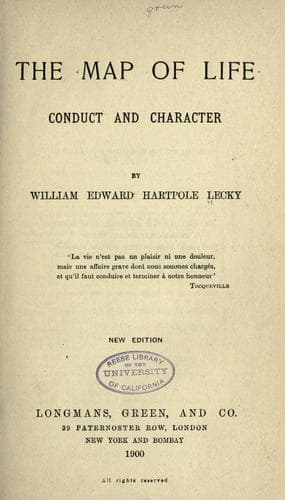
The Map of Life: Conduct and CharacterLecky, William Edward Hartpole
Philosophy
The Map of Life: Conduct and Character
Lecky, William Edward Hartpole
Character; Conduct of life
It was certainly not an appeal upon which great confidence could be
placed. Immediately after the _Coup d'état_, the army, which was wholly
on his side, voted separately and openly in order that France might
clearly know that the armed forces were with the President and might be
able to predict the consequences of a verdict unfavourable to his
pretensions. When, nearly three weeks later, the civilian Plébiscite
took place, martial law was in force. Public meetings of every kind were
forbidden. No newspaper hostile to the new authority was permitted. No
electioneering paper or placard could be circulated which had not been
sanctioned by Government officials. The terrible decree that all who had
ever belonged to a secret society might be sent to die in the fevers of
Africa was interpreted in the widest sense, and every political society
or organisation was included in it. All the functionaries of a highly
centralised country were turned into ardent electioneering agents, and
the question was so put that the voters had no alternative except for or
against the President, a negative vote leaving the country with no
government and an almost certain prospect of anarchy and civil war.
Under these circumstances 7,500,000 votes were given for the President
and 500,000 against him.
But after all deductions have been made there can be no real doubt that
the majority of Frenchmen acquiesced in the new _régime_. The terror of
Socialism was abroad, and it brought with it an ardent desire for strong
government. The probabilities of a period of sanguinary anarchy were so
great that multitudes were glad to be secured from it at almost any
cost. Parliamentarism was profoundly discredited. The peasant
proprietary had never cared for it, and the bourgeois class, among whom
it had once been popular, were now thoroughly scared. Nothing in the
contemporary accounts of the period is more striking than the
indifference, the almost amused cynicism, or the sense of relief with
which the great mass of Frenchmen seem to have witnessed the destruction
of their Constitution and the gross insults inflicted upon a Chamber
which included so many of the most illustrious of their countrymen.
Public-domain text, read in full here on John Shaqi.
Reviews
Reviews
No reviews yet
Be the first to share your thoughts on this work.
Elsewhere in the archive
Join the Discussion
Join the discussion
Sign in to leave a comment or review.
Sign InorCreate an account