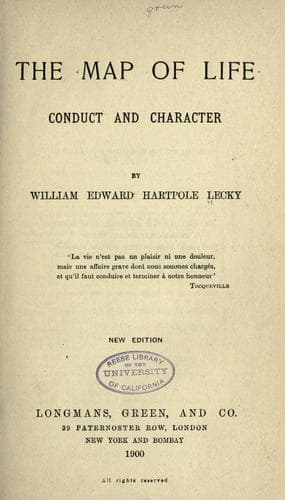
The Map of Life: Conduct and CharacterLecky, William Edward Hartpole
Philosophy
The Map of Life: Conduct and Character
Lecky, William Edward Hartpole
Character; Conduct of life
We can hardly have a better authority on this point than Tocqueville. No
one felt more profoundly or more bitterly the iniquity of what had been
done; but he was under no illusion about the sentiments of the people.
The Constitution, he says, was thoroughly unpopular. 'Louis Napoleon had
the merit or the luck to discover what few suspected--the latent
Bonapartism of the nation.... The memory of the Emperor, vague and
undefined, but therefore the more imposing, still dwelt like an heroic
legend in the imaginations of the people.' All the educated, in the
opinion of Tocqueville, condemned and repudiated the _Coup d'état_.
'Thirty-seven years of liberty have made a free press and free
parliamentary discussion necessary to us.' But the bulk of the nation
was not with them. The new Government, he predicted, 'will last until it
is unpopular with the mass of the people. At present the disapprobation
is confined to the educated classes.' 'The reaction against democracy
and even against liberty is irresistible.'[52]
There is no doubt some exaggeration on both sides of this statement.
The appalling magnitude of the deportations and imprisonments by the new
Government seems to show that the hatred went deeper than Tocqueville
supposed, and on the other hand it can hardly be said that the educated
classes wholly repudiated what had been done when we remember that the
French Funds at once rose from 91 to 102, that nearly all branches of
French commerce made a similar spring,[53] that some twenty generals
were actively engaged in the conspiracy, and that the great body of the
priests were delighted at its success. The truth seems to be that the
property of France saw in the success of the _Coup d'état_ an escape
from a great danger, while two powerful professions, the army and the
Church, were strongly in favour of the President. Over the army the name
of Napoleon exercised a magical influence, and the expedition to Rome
and the probability that the new government would be under clerical
guidance were, in the eyes of the Church party, quite sufficient to
justify what had been done.
Nothing, indeed, in this strange history is more significant than the
attitude assumed by the special leaders and representatives of the
Church which teaches that 'it were better for the sun and moon to drop
from heaven, for the earth to fail, and for all of the many millions
upon it to die of starvation in extremest agony, so far as temporal
affliction goes, than that one soul ... should commit one venial sin,
should tell one wilful untruth.'[54]
Public-domain text, read in full here on John Shaqi.
Reviews
Reviews
No reviews yet
Be the first to share your thoughts on this work.
Elsewhere in the archive
Join the Discussion
Join the discussion
Sign in to leave a comment or review.
Sign InorCreate an account