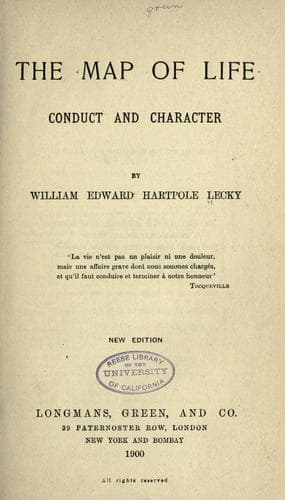
The Map of Life: Conduct and CharacterLecky, William Edward Hartpole
Philosophy
The Map of Life: Conduct and Character
Lecky, William Edward Hartpole
Character; Conduct of life
Cases of conflicting ethical judgments of another kind may be easily
cited. One of the best known was that of Governor Eyre at the time of
the Jamaica insurrection of 1865. In this case there was no question of
personal interest or ambition. The Governor was a man of stainless
honour, who in a moment of extreme difficulty and danger had rendered a
great service to his country. By his prompt and courageous action a
negro insurrection was quickly suppressed, which, if it had been allowed
to extend, must have brought untold horrors upon Jamaica. But the
martial law which he had proclaimed was certainly continued longer than
was necessary, it was exercised with excessive severity, and those who
were tried under it were not merely men who had been taken in arms. One
conspicuous civilian agitator, who had contributed greatly to stimulate
the insurrection, and had been, in the opinion of the Governor, its
'chief cause and origin,' but who, like most men of his kind, had merely
incited others without taking any direct part himself, was arrested in a
part of the island in which martial law was not proclaimed, and was
tried and hanged by orders of a military tribunal in a way which the
best legal authorities in England pronounced wholly unwarranted by law.
If this act had been considered apart from the general conditions of the
island it would have deserved severe punishment. If the services of the
Governor had been considered apart from this act they would have
deserved high honours from the Crown. In Jamaica the Governor was fully
supported by the Legislative Council and the Assembly, but at home
public opinion was fiercely divided, and the fact that the chief
literary and scientific men in England took sides on the question added
greatly to its interest. Carlyle took a leading part in the defence of
Governor Eyre. John Stuart Mill was the chairman of a committee who
regarded him as a simple criminal, and who for more than two years
pursued him with a persistent vindictiveness. As might have been
expected the one side dwelt solely on his services and the other side on
his misdeeds. Governor Eyre received no reward for the great service he
had rendered, and he was involved by his enemies in a ruinous legal
expenditure, which, however, was subsequently paid by the Government;
but those who desired to bring him to trial for murder were baffled, for
the Old Bailey Grand Jury threw out the bill. Public opinion, I think,
on the whole, approved of what they had done. Most moderate men had come
to the conclusion that Governor Eyre was a brave and honourable man who
had rendered great services to the State and had saved countless lives,
but who, through no unworthy motive and in a time of extreme danger and
panic, had committed a serious mistake which had been very amply
expiated.
Public-domain text, read in full here on John Shaqi.
Reviews
Reviews
No reviews yet
Be the first to share your thoughts on this work.
Elsewhere in the archive
Join the Discussion
Join the discussion
Sign in to leave a comment or review.
Sign InorCreate an account