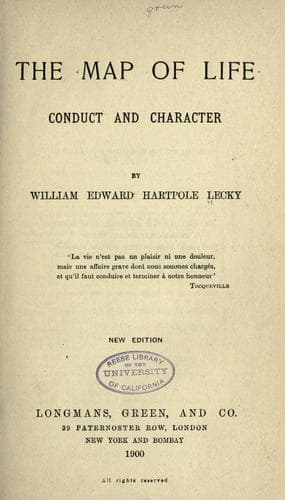
The Map of Life: Conduct and CharacterLecky, William Edward Hartpole
Philosophy
The Map of Life: Conduct and Character
Lecky, William Edward Hartpole
Character; Conduct of life
The more recent events connected with the Jameson raid into the
Transvaal may also be cited. Of the raid itself there is little to be
said. It was, in truth, one of the most discreditable as well as
mischievous events in recent colonial history, and its character was
entirely unrelieved by any gleam either of heroism or of skill. Those
who took a direct part in it were duly tried and duly punished. A
section of English society adopted on this question a disgraceful
attitude, but it must at least be said in palliation that they had been
grossly deceived, one of the chief and usually most trustworthy organs
of opinion having been made use of as an organ of the conspirators.
A more difficult question arose in the case of the statesman who had
prepared and organized the expedition against the Transvaal. It is
certain that the actual raid had taken place without his knowledge or
consent, though when it was brought to his knowledge he abstained from
taking any step to stop it. It may be conceded also that there were real
grievances to be complained of. By a strange irony of fate some of the
largest gold mines of the world had fallen to the possession of perhaps
the only people who did not desire them; of a race of hunters and
farmers intensely hostile to modern ideas, who had twice abandoned their
homes and made long journeys into distant lands in search of solitude
and space and of a home where they could live their primitive, pastoral
lives, undisturbed by any foreign element. These men now found their
country the centre of a vast stream of foreign immigration, and of that
most undesirable kind of immigration which gold mines invariably
promote. Their laws were very backward, but the part which was most
oppressive was that connected with the gold-mining industry which was
almost entirely in the hands of the immigrants, and it was this which
made it a main object to overthrow their government. The trail of
finance runs over the whole story, but it may be acknowledged that,
although Mr. Rhodes had made an enormous fortune by mining speculations,
and although he was largely interested as a financier in overturning the
system of government at Johannesburg, he was not a man likely to be
actuated by mere love of money, and that political ambition closely
connected with the opening and the civilisation of Africa largely
actuated him. Whether the motives of his co-conspirators were of the
same kind may be open to question. What, however, he did has been very
clearly established. When holding the highly confidential position of
Prime Minister of the Cape Colony, and being at the same time a Privy
Councillor of the Queen, he engaged in a conspiracy for the overthrow of
the government of a neighbouring and friendly State. In order to carry
out this design he deceived the High Commissioner whose Prime Minister
he was. He deceived his own colleagues in the Ministry. He collected
under false pretences a force which was intended to co-operate with an
Public-domain text, read in full here on John Shaqi.
Reviews
Reviews
No reviews yet
Be the first to share your thoughts on this work.
Elsewhere in the archive
Join the Discussion
Join the discussion
Sign in to leave a comment or review.
Sign InorCreate an account