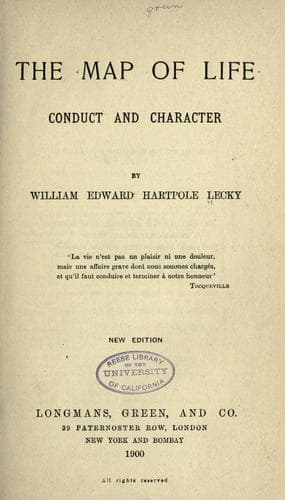
The Map of Life: Conduct and CharacterLecky, William Edward Hartpole
Philosophy
The Map of Life: Conduct and Character
Lecky, William Edward Hartpole
Character; Conduct of life
The necessities for moral compromise I have traced in the army, in the
law, and in the fields of politics may be found in another form not less
conspicuously in the Church. The members, and still more the ministers,
of an ancient Church bound to formularies and creeds that were drawn up
in long bygone centuries, are continually met by the difficulties of
reconciling these forms with the changed conditions of human knowledge,
and there are periods when the pressure of these difficulties is felt
with more than common force. Such, for example, were the periods of the
Renaissance and the Reformation, when changes in the intellectual
condition of Europe produced a widespread conviction of the vast amount
of imposture and delusion which had received the sanction of a Church
that claimed to be infallible, the result being in some countries a
silent evanescence of all religious belief among the educated class,
even including a large number of the leaders of the Church, and in other
countries a great outburst of religious zeal aiming at the restoration
of Christianity to its primitive form and a repudiation of the
accretions of superstition that had gathered around it. The Copernican
theory proving that our world is not, as was long believed, the centre
of the universe, but a single planet moving with many others around a
central sun, and the discovery, by the instrumentality of the
telescope, of the infinitesimally small place which our globe occupies
in the universe, altered men's measure of probability and affected
widely, though indirectly, their theological beliefs.
A similar change was gradually produced by the Newtonian discovery that
the whole system of the universe was pervaded by one great law, and by
the steady growth of scientific knowledge, proving that vast numbers of
phenomena which were once attributed to isolated and capricious acts of
spiritual intervention were regulated by invariable, inexorable,
all-pervasive law. Many of the formularies by which we still express our
religious beliefs date from periods when comets and eclipses were
believed to have been sent to portend calamity; when every great
meteorological change was attributed to some isolated spiritual agency;
when witchcraft and diabolical possession, supernatural diseases, and
supernatural cures were deemed indubitable facts: and when accounts of
contemporary miracles, Divine or Satanic, carried with them no sense of
strangeness or improbability. It is scarcely surprising that these
formularies sometimes seem incongruous with an age when the scientific
spirit has introduced very different conceptions of the government of
the universe, and when the miraculous, if it is not absolutely
discredited, is, at least in the eyes of most educated men, relegated to
a distant past.
Public-domain text, read in full here on John Shaqi.
Reviews
Reviews
No reviews yet
Be the first to share your thoughts on this work.
Elsewhere in the archive
Join the Discussion
Join the discussion
Sign in to leave a comment or review.
Sign InorCreate an account