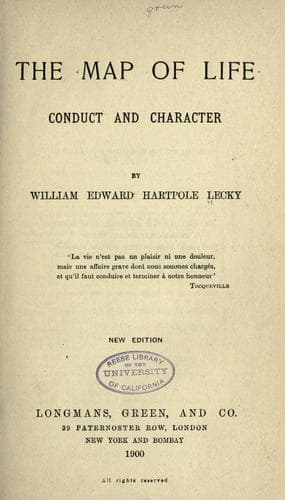
The Map of Life: Conduct and CharacterLecky, William Edward Hartpole
Philosophy
The Map of Life: Conduct and Character
Lecky, William Edward Hartpole
Character; Conduct of life
The present century has seen some powerful reactions towards older
religious beliefs, but it has also been to an unusual extent fertile in
the kind of changes that most deeply affect them. Not many years have
passed since the whole drama of the world's history was believed to
have been comprised in the framework of 'Paradise Lost' and 'Paradise
Regained.' Man appeared in the universe a faultless being in a faultless
world, but he soon fell from his first estate, and his fall entailed
world-wide consequences. It introduced into our globe sin, death,
suffering, disease, imperfection and decay; all the mischievous and
ferocious instincts and tendencies of man and beast; all the
multitudinous forms of struggle, terror, anxiety and grief; all that
makes life bitter to any living being, and, even as the Fathers were
accustomed to say, the briars and weeds and sterility of the earth.
Paradise Regained was believed to be indissolubly connected with
Paradise Lost. The one was the explanation of the other. The one
introduced the disease, the other provided the remedy.
It is idle to deny that the main outlines of this picture have been
wholly changed. First came the discovery that the existence of our globe
stretches far beyond the period once assigned to the Creation, and that
for countless ages before the time when Adam was believed to have lost
Paradise, death had been its most familiar fact and its inexorable law;
that the animals who inhabited it preyed upon and devoured each other as
at present, their claws and teeth being specially adapted for that
purpose. Even their half-digested remains have been preserved in fossil.
'Death,' wrote a Pagan philosopher, in sharp contrast to the teaching of
the Church, 'is a law and not a punishment,' and geology has fully
justified his assertion.
Then came decisive evidence showing that for many thousands of years
before his supposed origin man had lived and died upon our globe--a
being, as far as can be judged from the remains that have been
preserved, not superior but greatly inferior to ourselves, whose almost
only art was the manufacture of rude instruments for killing, who
appears in structure and in life to have approximated closely to the
lowest existing forms of savage life.
Public-domain text, read in full here on John Shaqi.
Reviews
Reviews
No reviews yet
Be the first to share your thoughts on this work.
Elsewhere in the archive
Join the Discussion
Join the discussion
Sign in to leave a comment or review.
Sign InorCreate an account