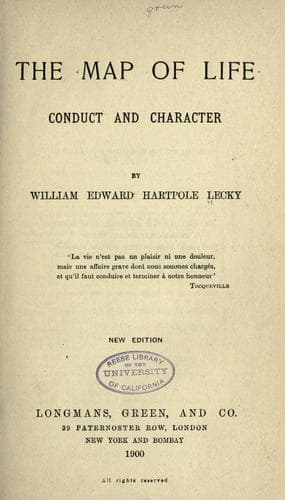
The Map of Life: Conduct and CharacterLecky, William Edward Hartpole
Philosophy
The Map of Life: Conduct and Character
Lecky, William Edward Hartpole
Character; Conduct of life
Then came the Darwinian theory maintaining that the whole history of the
living world is a history of slow and continuous evolution, chiefly by
means of incessant strife, from lower to higher forms; that man himself
had in this way gradually emerged from the humblest forms of the animal
world; that most of the moral deflections which were attributed to the
apple in Eden are the remains and traditions of the earlier and lower
stages of his existence. The theory of continuous ascent from a lower to
a higher stage took the place of the theory of the Fall as the
explanation of human history. It is a doctrine which is certainly not
without hope for the human race. It gives no explanation of the ultimate
origin of things, and it is in no degree inconsistent with the belief
either in a Divine and Creative origin or in a settled and Providential
plan. But it is as far as possible removed from the conception of human
history and human nature which Christendom during eighteen centuries
accepted as fundamental truth.
With these things have come influences of another kind. Comparative
Mythology has accumulated a vast amount of evidence, showing how myths
and miracles are the natural product of certain stages of human
history, of certain primitive misconceptions of the course of nature;
how legends essentially of the same kind, though with some varieties of
detail, have sprung up in many different quarters, and how they have
migrated and interacted on each other. Biblical criticism has at the
same time decomposed and analysed the Jewish writings, assigning to them
dates and degrees of authority very different from those recognised by
the Church. It has certainly not impaired their significance as records
of successive developments of religious and moral progress, nor has it
diminished their value as expressions of the loftiest and most enduring
religious sentiments of mankind; but in the eyes of a great section of
the educated world it has deprived them of the authoritative and
infallible character that was once attributed to them. At the same time
historical criticism has brought with it severer standards of proof,
more efficient means of distinguishing the historical from the fabulous.
It has traced the phases and variations of religions, and the influences
that governed them, with a fulness of knowledge and an independence of
judgment unknown in the past, and it has led its votaries to regard in
these matters a sceptical and hesitating spirit as a virtue, and
credulity and easiness of belief as a vice.
Public-domain text, read in full here on John Shaqi.
Reviews
Reviews
No reviews yet
Be the first to share your thoughts on this work.
Elsewhere in the archive
Join the Discussion
Join the discussion
Sign in to leave a comment or review.
Sign InorCreate an account