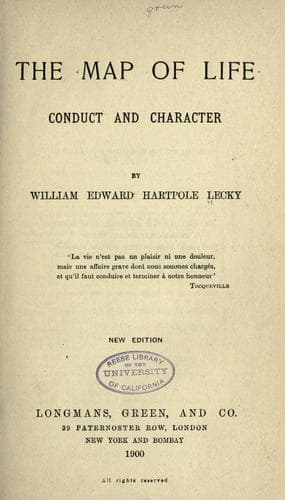
The Map of Life: Conduct and CharacterLecky, William Edward Hartpole
Philosophy
The Map of Life: Conduct and Character
Lecky, William Edward Hartpole
Character; Conduct of life
portions of the old ecclesiastical organisation as might be justified
from Scripture, but not regarding them as among the essentials of
Christianity; agreeing with other Protestant bodies in what was
fundamental, and differing from them mainly on points which were
non-essential; accepting cordially the principle that 'the Bible and
the Bible alone is the religion of Protestants,' and at the same time
separated by the gravest and most vital differences from what they
deemed the great apostasy of Rome.
It was argued on the one hand that in its ecclesiastical and legal
organisation the Church in England was identical with the Church in the
reign of Henry VII.; that there had been no breach of continuity; that
bishops, and often the same bishops, sat in the same sees before and
after the Reformation; that the great majority of the parochial clergy
were unchanged, holding their endowments by the same titles and tenures,
subject to the same courts, and meeting in Convocation in the same
manner as their predecessors; that the old Catholic services were merely
translated and revised, and that although Roman usurpations which had
never been completely acquiesced in had been decisively rejected, and
although many superstitious novelties had been removed, the Church of
England was still the Church of St. Augustine; that it had never, even
in the darkest period, lost its distinct existence, and that
supernatural graces and sacerdotal powers denied to all schismatics had
descended to it through the Episcopacy in an unbroken stream. On the
other hand it was argued that the essential of a true Church lay in the
accordance of its doctrines with the language of Scripture and not in
the methods of Church government, and that whatever might be the case in
a legal point of view, the theory of the unity of the Church before and
after the Reformation was in a theological sense a delusion. The Church
under Henry VII. was emphatically a theocracy or ecclesiastical
monarchy, the Pope, as the supposed successor of the supposed prince of
the Apostles, being the very keystone of the spiritual arch. Under Henry
VIII. and Elizabeth the Church of England had become a kind of
aristocracy of bishops, governed very really as well as theoretically by
the Crown, totally cut off from what called itself the Chair of Peter,
and placed under completely new relations with the Catholic Church of
Christendom. In this space of time Anglican Christianity had discarded
not only the Papacy but also great part of what for centuries before the
change had been deemed vitally and incontestably necessary both in its
theology and in its devotions. Though much of the old organisation and
many of the old formularies had been retained, its articles, its
homilies, the constant teaching of its founders, breathed a spirit of
unquestionable Protestantism. The Church which remained attached to
Rome, and which held the same doctrines, practised the same devotions,
Public-domain text, read in full here on John Shaqi.
Reviews
Reviews
No reviews yet
Be the first to share your thoughts on this work.
Elsewhere in the archive
Join the Discussion
Join the discussion
Sign in to leave a comment or review.
Sign InorCreate an account