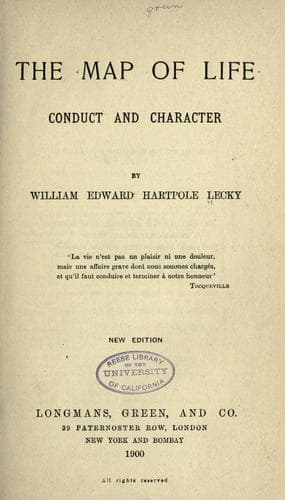
The Map of Life: Conduct and CharacterLecky, William Edward Hartpole
Philosophy
The Map of Life: Conduct and Character
Lecky, William Edward Hartpole
Character; Conduct of life
and performed the same ceremonies as the English Church under Henry
VII., professed to be infallible, and it utterly repudiated all
connection with the new Church of England, and regarded it as nothing
more than a Protestant schism; while the Church of England in her
authorised formularies branded some of the central beliefs and devotions
of the Roman Church as blasphemous, idolatrous, superstitious and
deceitful, and was long accustomed to regard that Church as the Church
of Antichrist; the Harlot of the Apocalypse, drunk with the blood of the
Saints. Each Church during long periods and to the full measure of its
powers suppressed or persecuted the other.
In the eyes of the Erastian and also in the eyes of the Puritan the
theory of the spiritual unity of these two bodies, and the various
sacerdotal consequences that were inferred from it, seemed incredible,
nor did the first generation of our reformers shrink from communion,
sympathy and co-operation with the non-episcopal Protestants of the
Continent. Although they laid great stress on patristic authority, and
consented--chiefly through political motives--to leave in the
Prayer-book many things derived from the older Church, yet the High
Church theory of Anglicanism is much more the product of the
seventeenth-century divines than of the reformers, just as Roman
Catholicism is much more akin to the later fathers than to primitive
Christianity. No one could doubt on what side were the sympathies and
what were the opinions of Cranmer, Latimer, Ridley, Jewell and Hooper,
and what spirit pervades the articles and the homilies. A Church which
does not claim to be infallible; which owes its special form chiefly to
the sagacity of statesmen; in which the supreme tribunal, deciding what
doctrines may be taught by the clergy, is a secular law court; in which
the bands of conformity are so loose that the tendencies and sentiments
of the nation give the complexion to the Church, appears in the eyes of
men of these schools to have no possible right to claim or share the
authority of the Church of Rome. It rests on another basis. It must be
justified on other grounds.
Public-domain text, read in full here on John Shaqi.
Reviews
Reviews
No reviews yet
Be the first to share your thoughts on this work.
Elsewhere in the archive
Join the Discussion
Join the discussion
Sign in to leave a comment or review.
Sign InorCreate an account