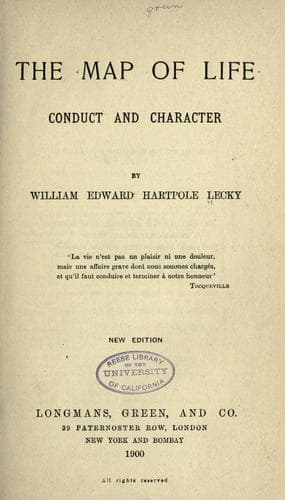
The Map of Life: Conduct and CharacterLecky, William Edward Hartpole
Philosophy
The Map of Life: Conduct and Character
Lecky, William Edward Hartpole
Character; Conduct of life
Take another test. Compare the _Guardian_, which represents better than
any other paper the opinions of moderate Churchmen, with the papers
which are most read by the French priesthood and have most influence on
their opinions. Certainly few English journalists have equalled in
ability Louis Veuillot, and few papers have exercised so great an
influence over the clergy of the Church as the _Univers_ at the time
when he directed it; but no one who read those savagely scurrilous and
intolerant pages, burning with an impotent hatred of all the progressive
and liberal tendencies of the time, shrinking from no misrepresentation
of fact and from no apology for crime if it was in the interest of the
Church, could fail to perceive how utterly out of harmony it was with
the best lay thought of France. English religious journalism has
sometimes, though in a very mitigated degree, exhibited some of these
characteristics, but no one who reads the _Guardian_, which I suppose
appeals to a larger clerical public than any other paper, can fail to
realise the contrast. It is not merely that it is habitually written in
the style and temper of a gentleman, but that it reflects most clearly
in its criticism, its impartiality, its tone of thought, the best
intellectual influences of the time. Men may agree or differ about its
politics or its theology, but no one who reads it can fail to admit that
it is thoroughly in touch with cultivated lay opinion, and it is in fact
a favourite paper of many who care only for its secular aspects.
The intellectual ability, however, included among the ministers of a
Church, though one test, is by no means a decisive and infallible one of
its religious life. During the period of the Renaissance, when genuine
belief in the Catholic Church had sunk to nearly its lowest point, most
men of literary tastes and talents were either members of the priesthood
or of the monastic orders. This was not due to any fervour of belief,
but simply to the fact that the Church at that time furnished almost the
only sphere in which a literary life could be pursued with comfort,
without molestation, and with some adequate reward. Much of the literary
ability found in the English Church is unquestionably due to the
attraction it offers and the facilities it gives to those who simply
wish for a studious life. The abolition of many clerical sinecures, and
the greatly increased activity of clerical duty imposed by contemporary
opinion, have no doubt rendered the profession less desirable from this
point of view; but even now there is no other profession outside the
universities which lends itself so readily to a literary life, and a
great proportion of the most eminent thinkers and writers in the Church
of England are eminent in fields that have little or no connection with
theology.
Public-domain text, read in full here on John Shaqi.
Reviews
Reviews
No reviews yet
Be the first to share your thoughts on this work.
Elsewhere in the archive
Join the Discussion
Join the discussion
Sign in to leave a comment or review.
Sign InorCreate an account