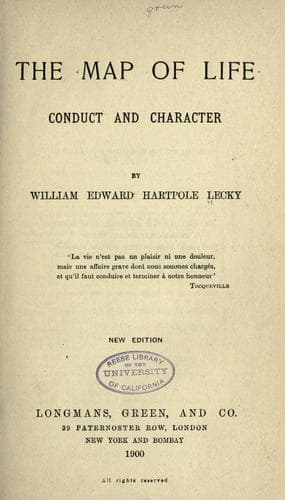
The Map of Life: Conduct and CharacterLecky, William Edward Hartpole
Philosophy
The Map of Life: Conduct and Character
Lecky, William Edward Hartpole
Character; Conduct of life
Nor can it be reasonably doubted that the Church has been very
efficacious in promoting that spiritual life which, whatever opinion men
may form of its origin and meaning, is at least one of the great
realities of human nature. The power of a religion is not to be solely
or mainly judged by its corporate action; by the institutions it
creates; by the part which it plays in the government of the world. It
is to be found much more in its action on the individual soul, and
especially in those times and circumstances when man is most isolated
from society. It is in furnishing the ideals and motives of individual
life; in guiding and purifying the emotions; in promoting habits of
thought and feeling that rise above the things of earth; in the comfort
it can give in age, sorrow, disappointment and bereavement; in the
seasons of sickness, weakness, declining faculties, and approaching
death, that its power is most felt. No one creed or Church has the
monopoly of this power, though each has often tried to identify it with
something peculiar to itself. It maybe found in the Catholic and in the
Quaker, in the High Anglican who attributes it to his sacramental
system, and in the Evangelical in whose eyes that system holds only a
very subordinate place. All that need here be said is that no one who
studies the devotional literature of the English Church, or who has
watched the lives of its more devout members, will doubt that this life
can largely exist and flourish within its pale.
The attitude which men who have been born within that Church, but who
have come to dissent from large portions of its theology, should bear to
this great instrument of good, is certainly not less perplexing than the
questions we have been considering in the preceding chapters. The most
difficult position is, of course, that of those who are its actual
ministers and who have subscribed its formularies. Each man so situated
must judge in the light of his own conscience. There is a great
difference between the case of men who accept such a position in the
Church though they differ fundamentally from its tenets, and the case of
men who, having engaged in its service, find their old convictions
modified or shaken, perhaps very gradually, by the advance of science or
by more matured thought and study. The stringency of the old form of
subscription has been much mitigated by an Act of 1865 which substituted
a general declaration that the subscriber believed in the doctrine of
the Church as a whole, for a declaration that he believed 'all and
everything' in the Articles and the Prayer-book. The Church of England
does not profess to be an infallible Church; it does profess to be a
National Church representing and including great bodies of more or less
divergent opinion, and the whole tendency of legal decisions since the
Gorham case has been to enlarge the circle of permissible opinion. The
possibility of the National Church remaining in touch with the more
Public-domain text, read in full here on John Shaqi.
Reviews
Reviews
No reviews yet
Be the first to share your thoughts on this work.
Elsewhere in the archive
Join the Discussion
Join the discussion
Sign in to leave a comment or review.
Sign InorCreate an account