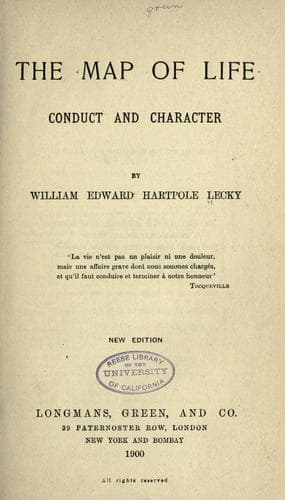
The Map of Life: Conduct and CharacterLecky, William Edward Hartpole
Philosophy
The Map of Life: Conduct and Character
Lecky, William Edward Hartpole
Character; Conduct of life
instructed and intellectual portions of the community depends mainly on
the latitude of opinion that is accorded to its clergy, and on their
power of welcoming and adopting new knowledge, and it may reasonably be
maintained that few greater calamities can befall a nation than the
severance of its higher intelligence from religious influences.
It should be remembered, too, that on the latitudinarian side the
changes that take place in the teaching of the Church consist much less
in the open repudiation of old doctrines than in their silent
evanescence. They drop out of the exhortations of the pulpit. The
relative importance of different portions of the religious teaching is
changed. Dogma sinks into the background. Narratives which are no longer
seriously believed become texts for moral disquisitions. The
introspective habits and the stress laid on purely ecclesiastical duties
which once preponderated disappear. The teaching of the pulpit tends
rather to the formation of active, useful and unselfish lives; to a
clearer insight into the great masses of remediable suffering and need
that still exist in the world; to the duty of carrying into all the
walks of secular life a nobler and more unselfish spirit; to a habit of
judging men and Churches mainly by their fruits and very little by their
beliefs. The disintegration or decadence of old religious beliefs which
had long been closely associated with moral teaching always brings with
it grave moral dangers, but those dangers are greatly diminished when
the change of belief is effected by a gradual transition, without any
violent convulsion or disruption severing men from their old religious
observances. Such a transition has silently taken place in England
among great numbers of educated men, and in some measure under the
influence of the clergy. Nor has it, I think, weakened the Church. The
standard of duty among such men has not sunk, but has in most
departments perceptibly risen: their zeal has not diminished, though it
flows rather in philanthropic than in purely ecclesiastical channels.
The conviction that the special dogmas which divided other Protestant
bodies from the Establishment rested on no substantial basis and have no
real importance tells in favour of the larger and the more liberal
Church, and the comprehensiveness which allows highly accentuated
sacerdotalism and latitudinarianism in the same Church is in the eyes of
many of them rather an element of strength than of weakness.
Public-domain text, read in full here on John Shaqi.
Reviews
Reviews
No reviews yet
Be the first to share your thoughts on this work.
Elsewhere in the archive
Join the Discussion
Join the discussion
Sign in to leave a comment or review.
Sign InorCreate an account