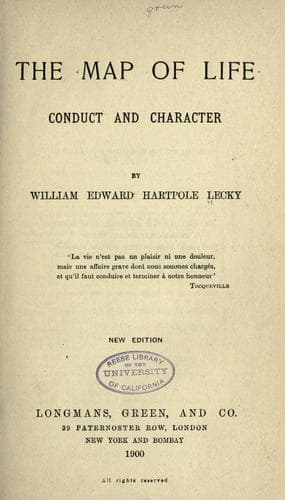
The Map of Life: Conduct and CharacterLecky, William Edward Hartpole
Philosophy
The Map of Life: Conduct and Character
Lecky, William Edward Hartpole
Character; Conduct of life
It is a question of a different kind whether the sacerdotal spirit which
has of late years so largely spread in the English Church can extend
without producing a violent disruption. To cut the tap roots of
priestcraft was one of the main aims and objects of the Reformation,
and, for reasons I have already stated, I do not believe that the party
which would re-establish it has by any means the strength that has been
attributed to it. It is true that the Broad Church party, though it
reflects faithfully the views of large numbers of educated laymen, has
never exercised an influence in active Church life at all proportionate
to the eminence of its leading representatives. It is true also that the
Evangelical party has in a very remarkable degree lost its old place in
the Anglican pulpit and in religious literature, though its tenets still
form the staple of the preaching of the Salvation Army and of most other
street preachers who exercise a real and widespread influence over the
poor. But the middle and lower sections of English society are, I
believe, at bottom, profoundly hostile to priestcraft; and although the
dread of Popery has diminished, they are very far from being ready to
acquiesce in any attempt to restore the dominion which their fathers
discarded.
In one respect, indeed, sacerdotalism in the Anglican Church is a worse
thing than in the Roman Church, for it is undisciplined and unregulated.
The history of the Church abundantly shows the dangers that have sprung
from the Confessional, though the Roman Catholic will maintain that its
habitually restraining and moralising influence greatly outweighs these
occasional abuses. But in the Roman Church the practice of confession is
carried on under the most severe ecclesiastical supervision and
discipline. Confession can only be made to a celibate priest of mature
age, who is bound to secrecy by the most solemn oath; who, except in
cases of grave illness, confesses only in an open church; and who has
gone through a long course of careful education specially and skilfully
designed to fit him for the duty. None of these conditions are observed
in Anglican Confession.
Public-domain text, read in full here on John Shaqi.
Reviews
Reviews
No reviews yet
Be the first to share your thoughts on this work.
Elsewhere in the archive
Join the Discussion
Join the discussion
Sign in to leave a comment or review.
Sign InorCreate an account