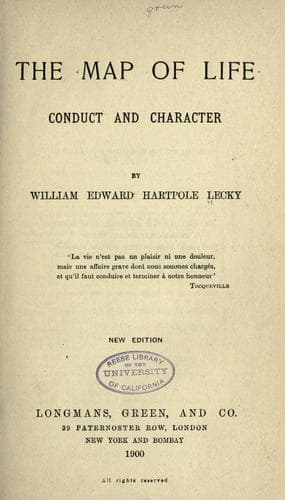
The Map of Life: Conduct and CharacterLecky, William Edward Hartpole
Philosophy
The Map of Life: Conduct and Character
Lecky, William Edward Hartpole
Character; Conduct of life
In other respects, indeed, the sacerdotal spirit is never likely to be
quite the same as in the Roman Church. A married clergy, who have mixed
in all the lay influences of an English university, and who still take
part in the pursuits, studies, social intercourse and amusements of
laymen, are not likely to form a separate caste or to constitute a very
formidable priesthood. It is perhaps a little difficult to treat their
pretensions with becoming gravity, and the atmosphere of unlimited
discussion which envelops Englishmen through their whole lives has
effectually destroyed the danger of coercive and restrictive laws
directed against opinion. Moral coercion and the tendency to interfere
by law on moral grounds with the habits of men, even when those habits
in no degree interfere with others, have increased. It is one of the
marked tendencies of Anglo-Saxon democracy, and it is very far from
being peculiar to, or even specially prominent in, any one Church. But
the desire to repress the expression of opinions by force, which for so
many centuries marked with blood and fire the power of mediæval
sacerdotalism, is wholly alien to modern English nature. Amid all the
fanaticisms, exaggerations, and superstitions of belief, this kind of
coercion, at least, is never likely to be formidable, nor do I believe
that in the most extreme section of the sacerdotal clergy there is any
desire for it. There has been one significant contrast between the
history of Catholicism and Anglicanism in the present century. In the
Catholic Church the Ultramontane element has steadily dominated,
restricting liberty of opinion, and important tenets which were once
undefined by the Church, and on which sincere Catholics had some
latitude of opinion, have been brought under the iron yoke. This is no
doubt largely due to the growth of scepticism and indifference, which
have made the great body of educated laymen hostile or indifferent to
the Church, and have thrown its management mainly into the hands of the
priesthood and the more bigoted, ignorant and narrow-minded laymen. But
in the Anglican Church educated laymen are much less alienated from
Church life, and a tribunal which is mainly lay exercises the supreme
authority. As a consequence of these conditions, although the sacerdotal
element has greatly increased, the latitude of opinion within the Church
has steadily grown.
Public-domain text, read in full here on John Shaqi.
Reviews
Reviews
No reviews yet
Be the first to share your thoughts on this work.
Elsewhere in the archive
Join the Discussion
Join the discussion
Sign in to leave a comment or review.
Sign InorCreate an account