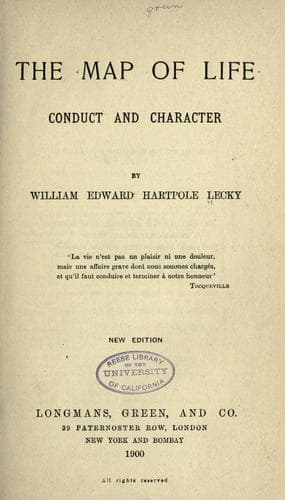
The Map of Life: Conduct and CharacterLecky, William Edward Hartpole
Philosophy
The Map of Life: Conduct and Character
Lecky, William Edward Hartpole
Character; Conduct of life
condition and increase or diminish his chances of disease and premature
death. The power of will over character is, however, stronger, or, at
least, wider than its power over the body. There are organs which lie
wholly beyond its influence; there are diseases over which it can
exercise no possible influence, but there is no part of our moral
constitution which we cannot in some degree influence or modify.
It has often seemed to me that diversities of taste throw much light on
the basis of character. Why is it that the same dish gives one man keen
pleasure and to another is loathsome and repulsive? To this simple
question no real answer can be given. It is a fact of our nature that
one fruit, or meat, or drink will give pleasure to one palate and none
whatever to another. At the same time, while the original and natural
difference is undoubted, there are many differences which are wholly or
largely due to particular and often transitory causes. Dishes have an
attraction or the reverse because they are associated with old
recollections or habits. Habit will make a Frenchman like his melon with
salt, while an Englishman prefers it with sugar. An old association of
ideas will make an Englishman shrink from eating a frog or a snail,
though he would probably like each if he ate it without knowing it, and
he could easily learn to do so. The kind of cookery which one age or one
nation generally likes, another age or another nation finds distasteful.
The eye often governs the taste, and a dish which, when seen, excites
intense repulsion, would have no such repulsion to a blind man. Every
one who has moved much about the world, and especially in uncivilised
countries, will get rid of many old antipathies, will lose the
fastidiousness of his taste, and will acquire new and genuine tastes.
The original innate difference is not wholly destroyed, but it is
profoundly and variously modified.
Public-domain text, read in full here on John Shaqi.
Reviews
Reviews
No reviews yet
Be the first to share your thoughts on this work.
Elsewhere in the archive
Join the Discussion
Join the discussion
Sign in to leave a comment or review.
Sign InorCreate an account