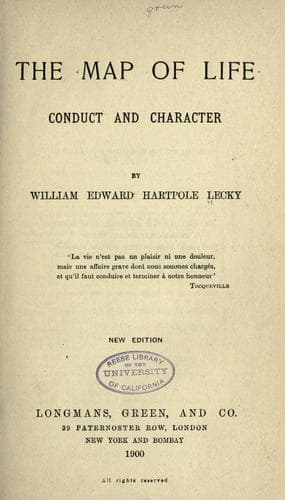
The Map of Life: Conduct and CharacterLecky, William Edward Hartpole
Philosophy
The Map of Life: Conduct and Character
Lecky, William Edward Hartpole
Character; Conduct of life
At the same time, it is difficult to believe that serious dangers do not
await the Church if the unprotestantising influences that have spread
within it continue to extend. It is not likely that the nation will
continue to give its support to the Church if that Church in its main
tendencies cuts itself off from the Reformation. The conversions to
Catholicism in England, though probably much exaggerated, have been very
numerous, and it is certainly not surprising that it should be so. If
the Church of Rome permitted Protestantism to be constantly taught in
her pulpits, and Protestant types of worship and character to be
habitually held up to admiration, there can be little doubt that many of
her worshippers would be shaken. If the Church of England becomes in
general what it already is in some of its churches, it is not likely
that English public opinion will permanently acquiesce in its privileged
position in the State. If it ceases to be a Protestant Church, it will
not long remain an established one, and its disestablishment would
probably be followed by a disruption in which opinions would be more
sharply defined, and the latitude of belief and the spirit of compromise
that now characterise our English religious life might be seriously
impaired.
FOOTNOTES:
[58] _Alciphron_, 6th Dialogue.
[59] Nalsons's _Collections_, i. 769, February 9, 1640.
[60] _Autobiography of Isaac Williams_, p. 132. This letter was written
in 1863.
CHAPTER XII
THE MANAGEMENT OF CHARACTER
Of all the tasks which are set before man in life, the education and
management of his character is the most important, and, in order that it
should be successfully pursued, it is necessary that he should make a
calm and careful survey of his own tendencies, unblinded either by the
self-deception which conceals errors and magnifies excellences, or by
the indiscriminate pessimism which refuses to recognise his powers for
good. He must avoid the fatalism which would persuade him that he has no
power over his nature, and he must also clearly recognise that this
power is not unlimited. Man is like a card-player who receives from
Nature his cards--his disposition, his circumstances, the strength or
weakness of his will, of his mind, and of his body. The game of life is
one of blended chance and skill. The best player will be defeated if he
has hopelessly bad cards, but in the long run the skill of the player
will not fail to tell. The power of man over his character bears much
resemblance to his power over his body. Men come into the world with
bodies very unequal in their health and strength; with hereditary
dispositions to disease; with organs varying greatly in their normal
condition. At the same time a temperate or intemperate life, skilful or
unskilful regimen, physical exercises well adapted to strengthen the
weaker parts, physical apathy, vicious indulgence, misdirected or
excessive effort, will all in their different ways alter his bodily
Public-domain text, read in full here on John Shaqi.
Reviews
Reviews
No reviews yet
Be the first to share your thoughts on this work.
Elsewhere in the archive
Join the Discussion
Join the discussion
Sign in to leave a comment or review.
Sign InorCreate an account