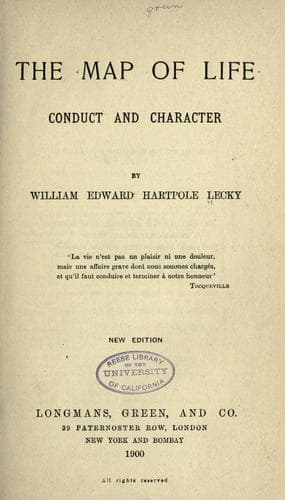
The Map of Life: Conduct and CharacterLecky, William Edward Hartpole
Philosophy
The Map of Life: Conduct and Character
Lecky, William Edward Hartpole
Character; Conduct of life
It is evident that there is a close analogy between these things and
that collection of likes and dislikes, moral and intellectual, which
forms the primal base of character, and which mainly determines the
complexion of our lives. As Marcus Aurelius said: 'Who can change the
desires of man?' That which gives the strongest habitual pleasure,
whether it be innate or acquired, will in the great majority of cases
ultimately dominate. Certain things will always be intensely
pleasurable, and certain other things indifferent or repellent, and this
magnetism is the true basis of character, and with the majority of men
it mainly determines conduct. By the associations of youth and by other
causes these natural likings and dislikings may be somewhat modified,
but even in youth our power is very limited, and in later life it is
much less. No real believer in free-will will hold that man is an
absolute slave to his desires. No man who knows the world will deny that
with average man the strongest passion or desire will prevail--happy
when that desire is not a vice.
Passions weaken, but habits strengthen, with age, and it is the great
task of youth to set the current of habit and to form the tastes which
are most productive of happiness in life. Here, as in most other things,
opposite exaggerations are to be avoided. There is such a thing as
looking forward too rigidly and too exclusively to the future--to a
future that may never arrive. This is the great fault of the
over-educationist, who makes early life a burden and a toil, and also of
those who try to impose on youth the tastes and pleasures of the man.
Youth has its own pleasures, which will always give it most enjoyment,
and a happy youth is in itself an end. It is the time when the power of
enjoyment is most keen, and it is often accompanied by such extreme
sensitiveness that the sufferings of the child for what seem the most
trivial causes probably at least equal in acuteness, though not in
durability, the sufferings of a man. Many a parent standing by the
coffin of his child has felt with bitterness how much of the measure of
enjoyment that short life might have known has been cut off by an
injudicious education. And even if adult life is attained, the evils of
an unhappy childhood are seldom wholly compensated. The pleasures of
retrospect are among the most real we possess, and it is around our
childish days that our fondest associations naturally cluster. An early
over-strain of our powers often leaves behind it lasting distortion or
weakness, and a sad childhood introduces into the character elements of
morbidness and bitterness that will not disappear.
Public-domain text, read in full here on John Shaqi.
Reviews
Reviews
No reviews yet
Be the first to share your thoughts on this work.
Elsewhere in the archive
Join the Discussion
Join the discussion
Sign in to leave a comment or review.
Sign InorCreate an account