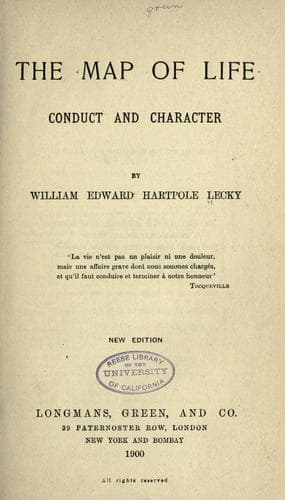
The Map of Life: Conduct and CharacterLecky, William Edward Hartpole
Philosophy
The Map of Life: Conduct and Character
Lecky, William Edward Hartpole
Character; Conduct of life
The first great rule in judging of pleasures is that so well expressed
by Seneca: 'Sic præsentibus utaris voluptatibus ut futuris non
noceas'--so to use present pleasures as not to impair future ones.
Drunkenness, sensuality, gambling, habitual extravagance and
self-indulgence, if they become the pleasures of youth, will almost
infallibly lead to the ruin of a life. Pleasures that are in themselves
innocent lose their power of pleasing if they become the sole or main
object of pursuit.
In starting in life we are apt to attach a disproportionate value to
tastes, pleasures, and ideals that can only be even approximately
satisfied in youth, health, and strength. We have, I think, an example
of this in the immense place which athletic games and out-of-door sports
have taken in modern English life. They are certainly not things to be
condemned. They have the direct effect of giving a large amount of
intense and innocent pleasure, and they have indirect effects which are
still more important. In so far as they raise the level of physical
strength and health, and dispel the morbidness of temperament which is
so apt to accompany a sedentary life and a diseased or inert frame, they
contribute powerfully to lasting happiness. They play a considerable
part in the formation of friendships which is one of the best fruits of
the period between boyhood and mature manhood. Some of them give lessons
of courage, perseverance, energy, self-restraint, and cheerful
acquiescence in disappointment and defeat that are of no small value in
the formation of character, and when they are not associated with
gambling they have often the inestimable advantage of turning young men
away from vicious pleasures. At the same time it can hardly be doubted
that they hold an exaggerated prominence in the lives of young
Englishmen of the present generation. It is not too much to say that
among large sections of the students at our Universities, and at a time
when intellectual ambition ought to be most strong and when the
acquisition of knowledge is most important, proficiency in cricket or
boating or football is more prized than any intellectual achievement. I
have heard a good judge, who had long been associated with English
University life, express his opinion that during the last forty or fifty
years the relative intellectual position of the upper and middle classes
in England has been materially changed, owing to the disproportioned
place which outdoor amusements have assumed in the lives of the former.
It is the impression of very competent judges that a genuine love,
reverence and enthusiasm for intellectual things is less common among
the young men of the present day than it was in the days of their
fathers. The predominance of the critical spirit which chills
enthusiasm, and still more the cram system which teaches young men to
look on the prizes that are to be won by competitive examinations as the
supreme end of knowledge, no doubt largely account for this, but much
Public-domain text, read in full here on John Shaqi.
Reviews
Reviews
No reviews yet
Be the first to share your thoughts on this work.
Elsewhere in the archive
Join the Discussion
Join the discussion
Sign in to leave a comment or review.
Sign InorCreate an account