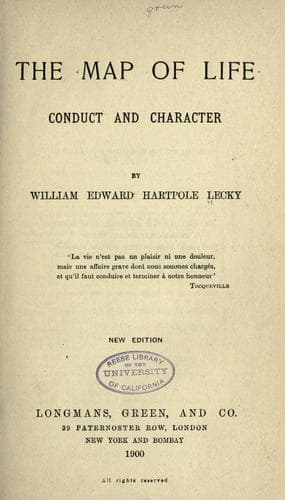
The Map of Life: Conduct and CharacterLecky, William Edward Hartpole
Philosophy
The Map of Life: Conduct and Character
Lecky, William Edward Hartpole
Character; Conduct of life
and doing for long periods what is distasteful and painful--is much less
cultivated than in some periods of the past.
Many things contribute to this. The rush and hurry of modern existence
and the incalculable multitude and variety of fleeting impressions that
in the great centres of civilisation pass over the mind are very
unfavourable to concentration, and perhaps still more to the direct
cultivation of mental states. Amusements, and the appetite for
amusements, have greatly extended. Life has become more full. The long
leisures, the introspective habits, the _vita contemplativa_ so
conspicuous in the old Catholic discipline, grow very rare. Thoughts and
interests are more thrown on the external; and the comfort, the luxury,
the softness, the humanity of modern life, and especially of modern
education, make men less inclined to face the disagreeable and endure
the painful.
The starting-point of education is thus silently changing. Perhaps the
extent of the change is best shown by the old Catholic ascetic training.
Its supreme object was to discipline and strengthen the will: to
accustom men habitually to repudiate the pleasurable and accept the
painful; to mortify the most natural tastes and affections; to narrow
and weaken the empire of the desires; to make men wholly independent of
outward circumstances; to preach self-renunciation as itself an end.
Men will always differ about the merits of this system. In my own
opinion it is difficult to believe that in the period of Catholic
ascendency the moral standard was, on the whole and in its broad lines,
higher than our own. The repression of the sensual instincts was the
central fact in ascetic morals; but, even tested by this test, it is at
least very doubtful whether it did not fail. The withdrawal from secular
society of the best men did much to restrict the influences for good,
and the habit of aiming at an unnatural ideal was not favourable to
common, everyday, domestic virtue. The history of sacerdotal and
monastic celibacy abundantly shows how much vice that might easily have
been avoided grew out of the adoption of an unnatural standard, and how
often it led in those who had attained it to grave distortions of
character. Affections and impulses which were denied their healthy and
natural vent either became wholly atrophied or took other and morbid
forms, and the hard, cruel, self-righteous fanatic, equally ready to
endure or to inflict suffering, was a not unnatural result. But
whatever may have been its failures and its exaggerations, Catholic
asceticism was at least a great school for disciplining and
strengthening the will, and the strength and discipline of the will form
one of the first elements of virtue and of happiness.
Public-domain text, read in full here on John Shaqi.
Reviews
Reviews
No reviews yet
Be the first to share your thoughts on this work.
Elsewhere in the archive
Join the Discussion
Join the discussion
Sign in to leave a comment or review.
Sign InorCreate an account