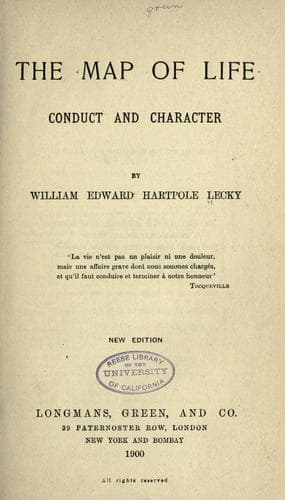
The Map of Life: Conduct and CharacterLecky, William Edward Hartpole
Philosophy
The Map of Life: Conduct and Character
Lecky, William Edward Hartpole
Character; Conduct of life
The same pleasures act differently on different characters, especially
on the differences of character that accompany difference of sex. I have
myself no doubt that the movement which in modern times has so widely
opened to women amusements that were once almost wholly reserved for men
has been on the whole a good one. It has produced a higher level of
health, stronger nerves, and less morbid characters, and it has given
keen and innocent enjoyment to many who from their circumstances and
surroundings once found their lives very dreary and insipid. Yet most
good observers will agree that amusements which have no kind of evil
effect on men often in some degree impair the graces or characters of
women, and that it is not quite with impunity that one sex tries to live
the life of the other. Some pleasures, too, exercise a much larger
influence than others on the general habits of life. It is not too much
to say that the invention of the bicycle, bringing with it an immense
increase of outdoor life, of active exercise, and of independent habits,
has revolutionised the course of many lives. Some amusements which may
in themselves be but little valued are wisely cultivated as helping men
to move more easily in different spheres of society, or as providing a
resource for old age. Talleyrand was not wholly wrong in his reproach to
a man who had never learned to play whist: 'What an unhappy old age you
are preparing for yourself!'
I have already mentioned the differences that may be found in different
countries and ages, in the relative importance attached to external
circumstances and to dispositions of mind as means of happiness, and the
tendency in the more progressive nations to seek their happiness mainly
in improved circumstances. Another great line of distinction is between
education that acts specially upon the desires, and that which acts
specially upon the will. The great perfection of modern systems of
education is chiefly of the former kind. Its object is to make knowledge
and virtue attractive, and therefore an object of desire. It does so
partly by presenting them in the most alluring forms, partly by
connecting them as closely as possible with rewards. The great principle
of modern moral education is to multiply innocent and beneficent
interests, tastes, and ambitions. It is to make the path of virtue the
natural, the easy, the pleasing one; to form a social atmosphere
favourable to its development, making duty and interest as far as
possible coincident. Vicious pleasures are combated by the
multiplication of healthy ones, and by a clearer insight into the
consequences of each. An idle or inert character is stimulated by
holding up worthy objects of interest and ambition, and it is the aim
alike of the teacher and the legislator to make the grooves and channels
of life such as tend naturally and easily towards good. But the
education of the will--the power of breasting the current of the desires
Public-domain text, read in full here on John Shaqi.
Reviews
Reviews
No reviews yet
Be the first to share your thoughts on this work.
Elsewhere in the archive
Join the Discussion
Join the discussion
Sign in to leave a comment or review.
Sign InorCreate an account