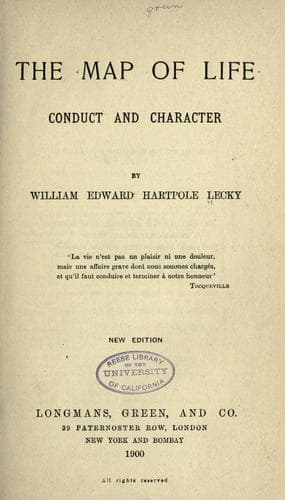
The Map of Life: Conduct and CharacterLecky, William Edward Hartpole
Philosophy
The Map of Life: Conduct and Character
Lecky, William Edward Hartpole
Character; Conduct of life
In courage itself, too, there are many varieties. The courage of the
soldier and the courage of the martyr are not the same, and it by no
means follows that either would possess that of the other. Not a few men
who are capable of leading a forlorn hope, and who never shrink from the
bayonet and the cannon, have shown themselves incapable of bearing the
burden of responsibility, enduring long-continued suspense, taking
decisions which might expose them to censure or unpopularity. The active
courage that encounters and delights in danger is often found in men who
show no courage in bearing suffering, misfortune, or disease. In passive
courage the woman often excels the man as much as in active courage the
man exceeds the woman. Even in active courage familiarity does much;
sympathy and enthusiasm play great and often very various parts, and
curious anomalies may be found. The Teutonic and the Latin races are
probably equally distinguished for their military courage, but there is
a clear difference between them in the nature of that courage and in the
circumstances or conditions under which it is usually most splendidly
displayed. The danger incurred by the gladiator was far greater than
that which was encountered by the soldier, but Tacitus[62] mentions
that when some of the bravest gladiators were employed in the Roman
army they were found wholly inefficient, as they were much less capable
than the ordinary soldiers of military courage.
The circumstances of life are the great school for forming and
strengthening the will, and in the excessive competition and struggle of
modern industrialism this school is not wanting. But in ethical and
educational systems the value of its cultivation is often insufficiently
felt. Yet nothing which is learned in youth is so really valuable as the
power and the habit of self-restraint, of self-sacrifice, of energetic,
continuous and concentrated effort. In the best of us evil tendencies
are always strong and the path of duty is often distasteful. With the
most favourable wind and tide the bark will never arrive at the harbour
if it has ceased to obey the rudder. A weak nature which is naturally
kindly, affectionate and pure, which floats through life under the
impulse of the feelings, with no real power of self-restraint, is indeed
not without its charm, and in a well-organised society, with good
surroundings and few temptations, it may attain a high degree of beauty;
but its besetting failings will steadily grow; without fortitude,
perseverance and principle, it has no recuperative energy, and it will
often end in a moral catastrophe which natures in other respects much
less happily compounded would easily avoid. Nothing can permanently
secure our moral being in the absence of a restraining will basing
itself upon a strong sense of the difference between right and wrong,
upon the firm groundwork of principle and honour.
Public-domain text, read in full here on John Shaqi.
Reviews
Reviews
No reviews yet
Be the first to share your thoughts on this work.
Elsewhere in the archive
Join the Discussion
Join the discussion
Sign in to leave a comment or review.
Sign InorCreate an account